Pre-Send Linting vs. Post-Send Monitoring for Agentic Email
Catching malformed messages before send beats waiting for complaints after delivery.

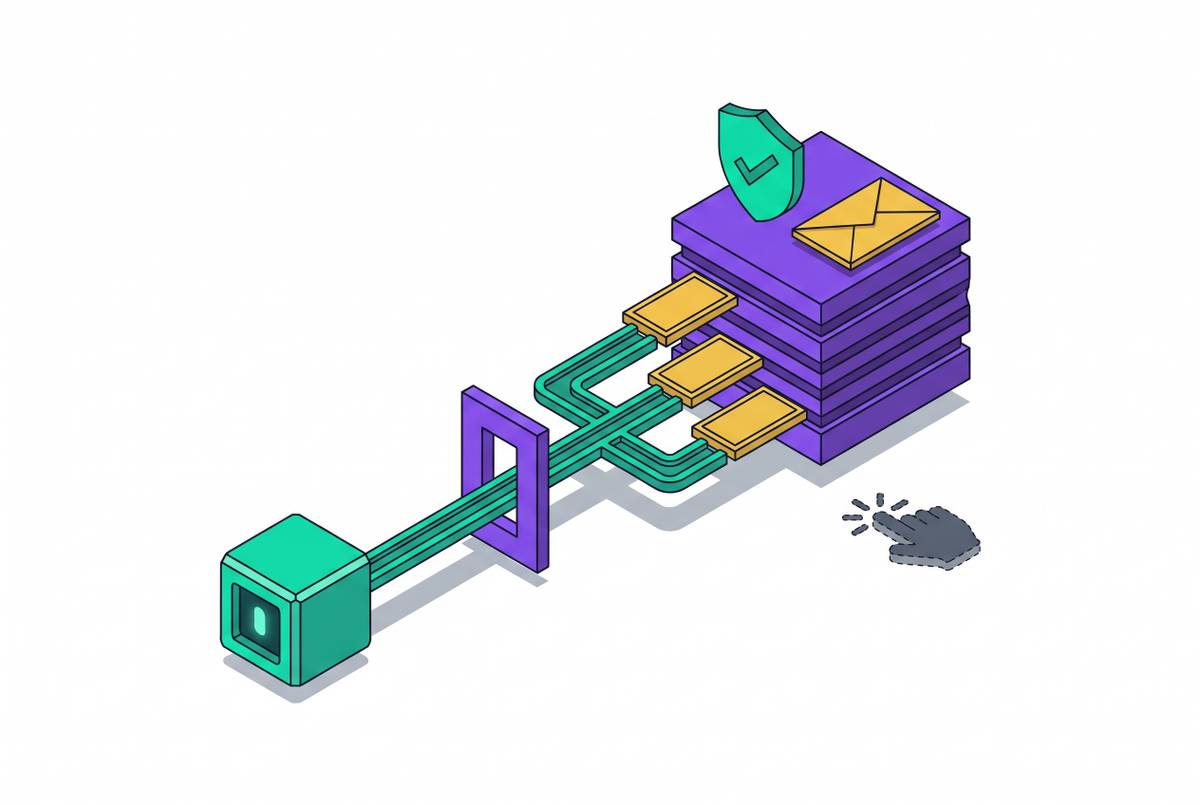
Pre-send linting and guardrails for agentic email must block malformed or non-compliant messages before delivery. Platform-level validation can catch broken merge tags, missing unsubscribe links, and suppressed recipients while the agent still has time to fix its send. Post-send monitoring remains necessary for reputation management, but it cannot serve as the primary safeguard for an autonomous sender.
Why the human review assumption is the wrong foundation for agent-sent email
Traditional email APIs were designed for developers who compose, review, and dispatch messages with human judgment in the process. Agentic email inverts that arrangement because the agent writes, configures, and dispatches without a human reviewer. The API is the last place to check a message before delivery. Infrastructure designed mainly to transport a reviewed message therefore occupies a different role when an agent calls it. It must mediate between the agent’s intent and an action that reaches a recipient.
The architectural gap is not connectivity or deliverability. A platform can accept a send request and deliver it successfully while allowing the wrong content or a non-compliant message through. Successful transport does not establish that the message was fit to send. When the infrastructure assumes someone else has made that judgment, removing the human leaves the assumption intact but the safeguard absent. The relevant distinction is therefore whether the sending platform depends on review outside its boundary or enforces checks knowing that no human will intervene.
What agents actually do that makes silent failures so likely
With dynamic personalization, template rendering can fail again and again. An agent can compose a message from structured data, leave {{first_name}} as literal text, and dispatch it to thousands of addresses before any signal returns. One gap in the upstream data can affect the whole batch. Because the send request can otherwise be valid, a delivery API need not reject it merely because the recipient will see an unfinished message. The defect is in the output.
A webhook redelivery or an orchestrator retry can re-trigger the same agent step, turning recovery logic into a duplicate-send loop. Idempotency is not guaranteed simply because retries work. The workflow needs both a way to retry a failed tool call and a way to stop it from repeating the send. Otherwise, infrastructure behaving correctly at one level can produce an unwanted result at another.
Compliance creates the same problem without a rendering error or a retry. An agent composing marketing email has no intrinsic awareness of whether an unsubscribe link is present, whether the List-Unsubscribe header is set, or whether a recipient appears on a suppression list. Those checks need an explicit enforcement point. Agents also adapt targeting, content, and timing between runs, so reviewing a static template does not establish what the next run will send or to whom. Their autonomy changes the inputs while their throughput amplifies the consequences, allowing a single bad decision to become thousands of bad sends.
Why post-send monitoring cannot catch these failures in time
Post-send monitoring observes outcomes. Complaint rates, bounce trends, and spam classification are available only after sending starts and results come back. By the time a complaint shows that a merge tag was left unresolved or a message went to the wrong recipient, that message has already left the system. Monitoring can inform the next decision, but it cannot reverse the decision that produced its evidence.
Aggregate signals also describe a different object from the defect a developer needs to fix. A complaint rate crossing a hard threshold does not identify which template variable failed to render or which segment was sent to the wrong list. It reports accumulated damage. That distinction limits monitoring even when an alert arrives promptly, because detecting a reputation problem is not the same as locating a malformed field.
The detection delay becomes more consequential at agent throughput. The 2025 deliverability benchmarks place the complaint rate hard ceiling at 0.3%, and an agent can exhaust the safe headroom between the start of a problem and a monitoring alert. The window is incompatible with machine-speed dispatch. Faster dashboard review does not change where the signal originates, since complaints still require recipients to have received and reacted to messages. A human checking those dashboards weekly adds latency to a control that is already downstream of the action it is meant to constrain.
Gmail moved to permanent rejections with hard numeric failure codes in November 2025. Microsoft Outlook escalated to full hard rejections in April 2026 after its initial May 2025 step routed mail to Junk. When marketing and transactional streams share domain, DKIM, or IP reputation signals, a single agent failure episode can spill over into delivery failures for subsequent transactional messages, although properly isolated transactional infrastructure reduces that risk.
The strongest objection is that monitoring may be sufficient for a low-volume agent. At low volume, fewer messages can leave before someone spots a defect, so fewer people may see the broken message. But volume is precisely what agents are used to scale. An arrangement that seems tolerable during a limited workflow loses that justification as the workflow succeeds and sends more autonomously.
This is why post-send monitoring is the wrong primary gate for malformed or non-compliant messages. It can track reputation and suppress future delivery after bad outcomes. By the time an alert or a later suppression takes effect, the original broken message has already reached an inbox. The primary control must operate at a point where rejecting a request still prevents the send.
How do pre-send checks prevent broken merge tags and missing unsubscribe links?
Pre-send linting inspects the message between the agent’s send call and the delivery infrastructure. It intercepts an enumerable class of defects while the message can still be stopped, including unresolved template variables, missing unsubscribe elements, and recipients on suppression lists. These are concrete conditions in the proposed send. They do not require a complaint trend or an inference about future inbox placement. A message with an unrendered variable can be rejected because the variable remains unresolved, without waiting to discover whether recipients object.
The rejection contract is as important as the check. An agent needs more detail than a generic error response provides: a typed error code, the specific field that failed, and a concrete fix. For a body containing literal {{first_name}}, a well-formed linting response would identify an unresolved template variable as the error type, locate it in the message body, and instruct the agent to supply the missing value and render the template before retrying. With a generic response, the orchestrator lacks the structured information it needs to tell a rendering defect from another invalid request.
Application-layer guardrails can validate the usual wrapper while a second code path, a retried tool call, or a new agent step bypasses it. Platform-level validation still intercepts those requests before delivery. The boundary is the send operation itself. This is especially important when an agent can vary its sequence of actions.
Compliance enforcement belongs at that same boundary. Unsubscribe headers and suppression checks should be on by default. The checks must also catch missing unsubscribe links before the message goes out. These checks address specified compliance defects rather than promising that linting can determine every aspect of a message’s suitability. The value comes from enforcing known requirements at send time and returning failures in a form the agent can use to correct and retry.
Where post-send monitoring fits once the linting layer is in place
Inbox placement depends on conditions that cannot be settled at compose time. ISP-side filtering, per-mailbox reputation signals, and engagement history with a particular recipient domain remain outside the scope of template and compliance checks. These conditions cannot simply be linted away. Post-send monitoring therefore owns the probabilistic reputation class over time, while pre-send linting owns the deterministic error class at send time. Passing validation establishes that the inspected requirements were met.
The monitoring layer needs continuous observation of complaint trends, bounce trajectories, and domain reputation scores, with configurable alert thresholds and authority to auto-suppress. A dashboard alone is not an operating loop. Within that loop, daily checks belong at the mailbox-provider level and cover spam rate, domain reputation, and IP reputation through Gmail Postmaster Tools and equivalent Microsoft tooling. Weekly checks cover DMARC aggregate reports, blocklist status, and bounce rate trends.
What this architecture requires from the infrastructure layer, and why purpose-built tooling matters
Building this architecture on infrastructure designed for human senders leaves the developer responsible for the missing linting layer. A conventional delivery API does not necessarily recognize agent-generated messages, validate template rendering, or enforce compliance headers by default. Its errors may also be oriented toward human dashboards. The developer must build a control that remains complete across retries and alternate code paths, even though this control is most likely to be incomplete, bypassed, or forgotten under deadline.
Platform-level pre-send validation must also cover sends outside the application wrapper, and machine-readable, typed errors must say what to fix. Compliance defaults must already be enabled. Idempotency support is needed for transactional sends, while rate-limit signals must be parseable and actionable by an orchestrator without human interpretation. These five properties define a stronger evaluation standard than whether an agent can successfully call an email API, because they address how the platform handles an unsafe or repeated request.
MCP-native tooling adds a requirement about where the response returns. When an agent invokes send_email as a registered MCP tool, the linting result needs to arrive in the same tool-use cycle. A separate webhook or dashboard alert breaks that correction path. Returning the error through the tool call lets the agent correct and retry within that interaction rather than depend on a human to translate an operational notification.
AgentSend’s position as purpose-built infrastructure belongs in this design discussion, rather than in a vendor ranking unsupported by comparable guardrail evidence. The platform should make these controls part of every send, even when validation is offered as an optional feature. Purpose-built tooling should remove the assumption that a careful operator will catch what the transport layer ignores. That is the developer’s actual infrastructure decision. When an agent receives the keys to a sending domain, the platform either catches a preventable problem before it ships or it does not, and pre-send linting should be its default behavior. GIC - Agent Send, a transactional and marketing email platform built for autonomous agent workflows, enforces that linting layer on every outbound call, returning typed, machine-readable errors so the agent can correct and retry before anything reaches a recipient.
Sources
- Infrastructure for the Agentic Web: Gap Analysis and Architecture from the Agentverse Platform
- Agentic Software: How AI Agents Are Restructuring the Software Paradigm
- Guardrails - Docs by LangChain
- Monitoring Agentic Systems Before They're Reliable
- Agentic artificial intelligence (AI) systems and methods for secure, compliant, multi-agent LLM-assisted networked communications