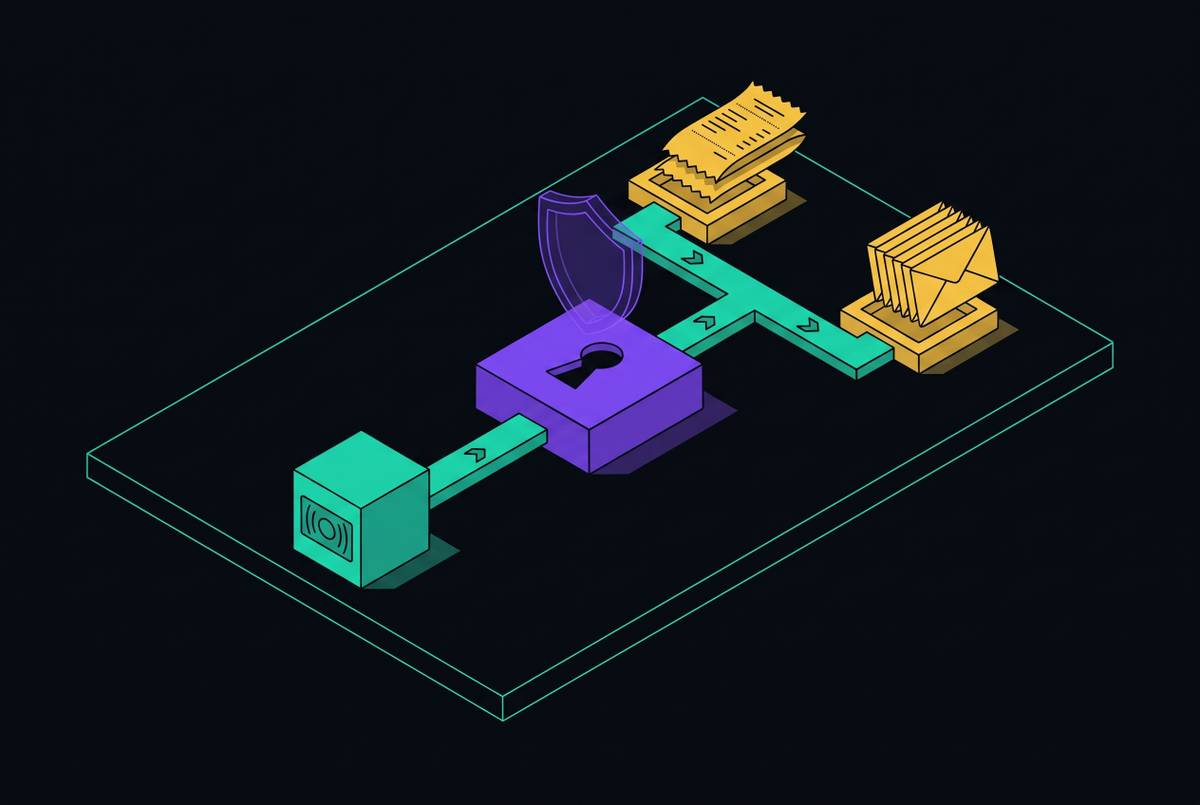
Separating Sending Domains for Transactional vs. Marketing Agent Traffic
Autonomous email agents need separate domains to prevent one traffic type from sabotaging the other.
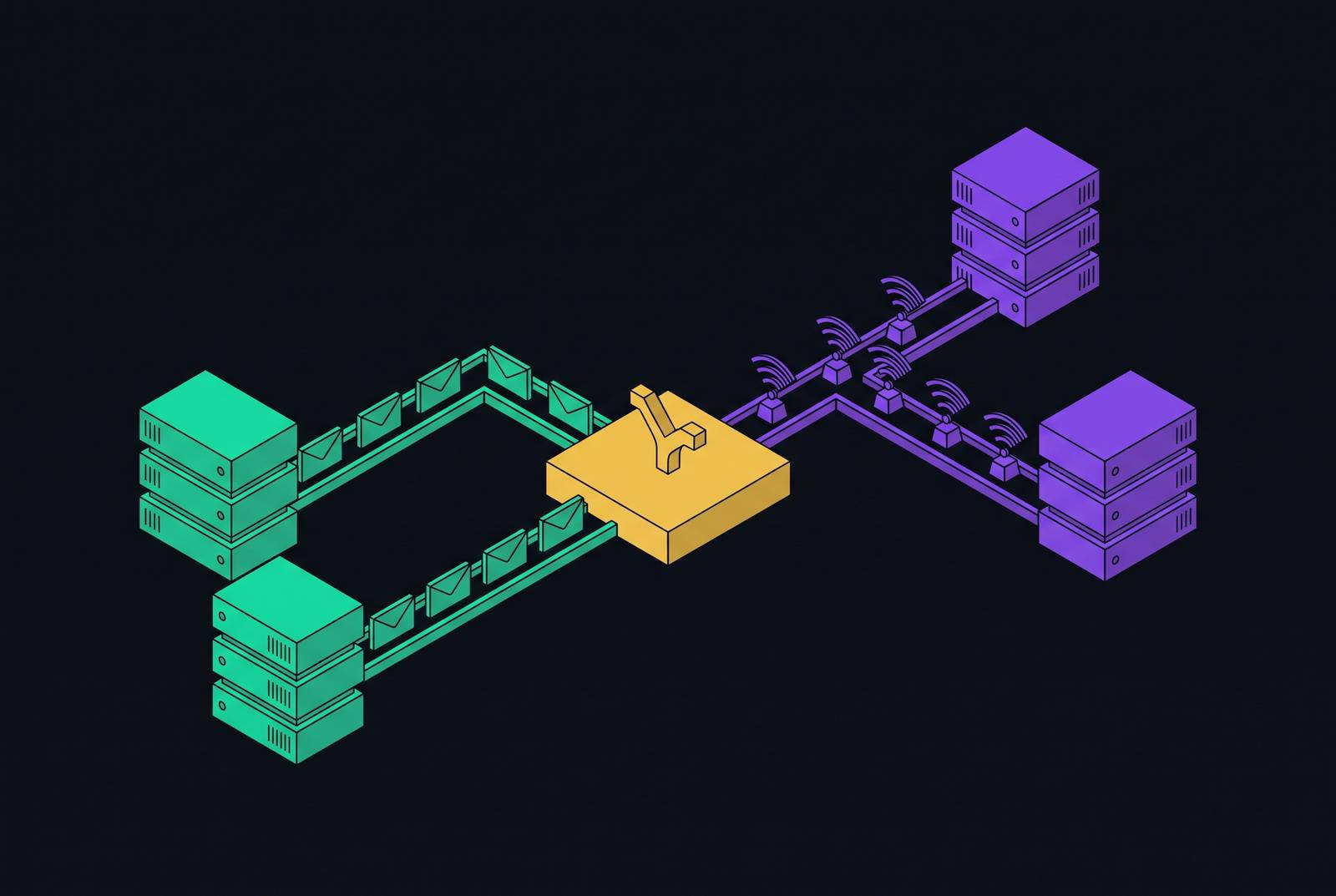
Separating transactional and marketing email onto distinct sending domains has always been sound practice. AI agents that dispatch both streams autonomously turn that practice into a hard architectural requirement, because the agent removes the human reviewer who catches reputation drift before it compounds. The reasoning runs through how inbox providers model sender behavior, how shared infrastructure fails, and what changes when no human sits between the agent and the queue.
Why transactional and marketing email have always been treated as different traffic by inbox providers
Inbox providers do not classify email by what the sender calls it. They classify by intent and behavioral pattern. A transactional message signals urgency and an expected action: a receipt, a login code, a password reset. A marketing message signals promotional content with uncertain engagement. These are different objects, and the provider's machine learning models treat them as such from the first message a domain sends.
That classification is enforced by models that read the full history of a domain and IP, not just the content of an individual message. The result is worse placement for both streams, not some average of where each would land on its own. A domain that sends receipts and newsletters from the same identity teaches the provider nothing reliable about either stream.
The compliance obligations attached to each stream are also structurally different. Transactional mail triggered by a user action has none of those obligations. Gmail and Yahoo require RFC 8058 one-click unsubscribe for bulk marketing and subscription messages. Microsoft recommends but does not require it. The requirement explicitly does not apply to transactional messages.
This means compliance on a shared domain cannot be enforced cleanly. Which rule applies depends on the content of each individual message, not on a property of the domain. Adding promotional content to a receipt or alert reclassifies the message as marketing and brings the full compliance obligation with it. A single shared domain has no stable rule set, because the rule set changes with every message the system dispatches.
How reputation contamination works when the streams share infrastructure
Reputation contamination is not a theoretical risk. It is the documented failure mode of shared sending infrastructure, and it operates at three levels simultaneously: domain, IP, and delivery queue. At the domain level, spam complaints and high unsubscribe rates from marketing sends land on the shared domain. Because reputation is domain-wide, even well-formatted transactional messages inherit the signal. A password reset sent from a domain that just ran a sloppy campaign carries the campaign's complaint history with it.
At the IP level, the failure is more immediate. A marketing campaign that hits a spam trap or generates a complaint spike can blacklist the sending IP. Every transactional message queued behind it, password resets, login codes, receipts, is blocked for the duration of the remediation. The queue level compounds this further. If both streams share the same outbound infrastructure, a marketing spike can hold up time-critical transactional messages for minutes or hours at peak. A login code that arrives twenty minutes late is functionally useless.
A subdomain split alone does not solve all three levels. Separate subdomains give mailbox providers distinct domain signals, but if both subdomains share one IP pool and one delivery queue, the IP-level and queue-level risks stay fully intact. The complete solution requires both subdomain separation and dedicated IP pools or separate ESPs. Each separated subdomain also needs its own SPF, DKIM, and DMARC records. Authentication does not inherit from the parent domain, so a subdomain without its own records gains none of the isolation it was created to provide.
What changes when an AI agent replaces the human operator in this picture
AI agents operating autonomously remove the human review layer that has historically caught reputation drift before it compounds. An agent dispatching email autonomously has no such checkpoint unless one is built into the infrastructure itself. The asymmetry is not about agent capability. By the time a monitoring dashboard shows a complaint spike or a bounce rate anomaly, an agent may have sent the same malformed message to thousands of recipients.
This is the distinction between post-send monitoring and pre-send validation. Pre-send validation intercepts a malformed or non-compliant message before any recipient sees it. The queue-level risk is especially acute because agents work with no human watching the intermediate states. Pre-send validation that checks message format and delivery queue constraints before an agent commits to sending is what separates catching the problem from letting it compound.
Agents also introduce retry behavior that has no equivalent in human workflows, and that turns a single infrastructure decision into a potential volume crisis. Complaint rates spike immediately, and reputation damage follows within hours, not days. If the agent sends both streams through shared infrastructure, the storm in one stream contaminates the other with no circuit breaker between them.
The compliance obligation is especially dangerous in the agent context because the agent generating marketing content cannot reliably know which compliance headers to attach unless the infrastructure enforces them unconditionally. Since Gmail rejects non-compliant bulk mail with temporary 4xx deferrals and permanent hard 5xx SMTP errors, the domain can be hard-blocked before a human reviewer sees the issue. SMTP2GO's 2026 email strategy guide identifies authentication, low complaint rates, and one-click unsubscribe as table stakes, not aspirational targets, for any sender that wants reliable inbox placement. GIC - Agent Send implements pre-send guardrails that validate compliance rules before delivery, ensuring that a shared domain cannot accidentally drift into non-compliance when an agent composes a message. Domain separation is what makes per-stream enforcement possible: with a dedicated marketing subdomain, compliance headers can be required unconditionally for every message leaving that domain. With a shared domain, the infrastructure cannot distinguish which compliance rule applies without inspecting message content at send time.
The architecture that actually separates the two streams — what it includes and why each part matters
Full separation requires decisions at four distinct layers. Getting three of four right still leaves a contamination vector open. The first layer is subdomain naming and structure. Campaigns go on a dedicated marketing subdomain, such as marketing.example.com. Receipts, login codes, password resets, and account alerts go on a dedicated transactional subdomain, such as tx.example.com. The root domain stays reserved for employee and brand mail. If promotional content becomes the primary purpose, the message routes through the marketing stream.
A separate root domain, such as example-mail.com, is warranted only when the primary domain carries historical abuse, when a marketing program is managed by a separate team with fully independent infrastructure, or when a specific legal or brand reason demands complete separation. More than two subdomains are rarely necessary early on. A security alert stream may eventually justify its own subdomain with a stricter DMARC policy, but a two-subdomain model handles most teams' needs.
The second layer is authentication per stream. SPF, DKIM, and DMARC records must be configured independently for each subdomain. They do not inherit from the parent domain. DMARC policy should be tuned to stream risk. A transactional subdomain handling login codes and password resets warrants p=reject to block spoofing. A marketing subdomain in early operation may hold at p=quarantine and move to p=reject once all sending tools are authenticated and stable. Each subscription list should carry a human-readable identifier in the List-ID header, or a unique From address per list. Gmail explicitly prescribes this for subscription mail to keep streams distinguishable to both providers and recipients.
The third layer is IP and ESP separation. IP-level isolation needs dedicated IP pools or separate ESPs for each stream. It eliminates shared queue congestion and means a penalty on the marketing provider has zero effect on the transactional provider.
The fourth layer is the tooling and API layer, where agents make enforcement non-negotiable. The infrastructure must enforce stream-specific rules at the API or MCP level, before any message reaches the queue. For marketing traffic, List-Unsubscribe and List-Unsubscribe-Post headers are required unconditionally on every outbound message, the suppression list is checked before dispatch, and unsubscribes are processed within 48 hours. For transactional traffic, idempotency keys are enforced at the API level to prevent retry-driven duplicate sends, delivery is immediate rather than batched, and bounce suppression follows the first hard bounce.
An email infrastructure purpose-built for autonomous agents recognizes that reputation contamination, IP-level blocking, and queue congestion are not edge cases but the default failure mode when agents lack pre-send visibility into the consequences of their sends. GIC - Agent Send treats domain separation and delivery queue isolation as first-class requirements, not optional tuning. Because the platform covers both transactional and marketing sending through one API and MCP server, a developer does not need to wire together separate tools for each stream. The stream-specific rules are enforced at the infrastructure layer, not left to the agent to remember.
How to migrate to separated domains without disrupting delivery in progress
The migration risk is real but manageable if the transition is sequenced by stream, starting with transactional, and uses a warm-up ramp rather than a hard cutover. The first step is to map current flows before touching DNS. Identify every sending path, the subdomain or domain it uses, the ESP or API it routes through, and the volume and cadence of each stream. A cutover made without this map will break flows that were not known to exist.
The second step is to create and authenticate the new subdomains first, and send nothing yet. Provision SPF, DKIM, and DMARC records for each new subdomain. Authentication that is not aligned at this stage will fail silently later, and the failure will look like a reputation problem rather than a configuration one.
The third step is to migrate transactional traffic first. Transactional mail has lower volume, higher engagement, and more predictable patterns. It warms up a new sending identity faster and with lower risk than marketing. A higher rate on the new subdomain signals that the signup form is not validating addresses at entry, and that should be fixed at the source rather than in the bounce handler.
The fourth step is to ramp marketing traffic gradually on the new domain. Start with the most engaged segment of the marketing list. Increase volume in increments over several weeks. A new domain with no sending history will be treated cautiously by inbox providers. Sending at full campaign volume immediately will trigger throttling on a domain that has not yet established a reputation.
The fifth step is to enforce stream rules in the tooling before going live. For teams using an agent-driven sending workflow, the pre-send linting and compliance enforcement layer should be in place and verified before the new domain carries live traffic. The machine-readable error responses from the linting layer are specifically useful during migration testing: an agent that attempts a non-compliant send gets a structured error identifying exactly which header or field is missing, so the fix can be made before the domain's reputation is established on a bad send.
Ongoing monitoring once the streams are separated — what to watch and why shared metrics mislead
Once separated, the two streams need independent monitoring. Aggregating their metrics defeats the purpose of the separation and recreates the signal noise that motivated it. Transactional metrics should be tracked independently: delivery rate with a target above 99%, bounce rate below half a percent on known addresses, and time to delivery. Marketing metrics are a different set: inbox placement rather than just delivery rate, because delivery rate counts spam folder delivery as success, plus complaint rate, unsubscribe rate, and DMARC aggregate report failures per sending subdomain.
In an agentic sending workflow, monitoring must be augmented with pre-send interception. Post-send metrics alone cannot catch the failure modes agents introduce. An unrendered template variable, with {{first_name}} appearing literally in a password reset email, will not show up in bounce or complaint metrics at all. It reaches the inbox, damages trust, and is invisible to deliverability monitoring.
Pre-send linting that validates every outbound message for compliance headers, template rendering, and idempotency before dispatch is the only layer that catches these failures before they reach recipients. DMARC reports should be reviewed per subdomain on a regular cadence. A spoofing attempt against the transactional subdomain is more urgent than one against the marketing subdomain, and stream-level policies make it possible to respond proportionately. Separation is not a one-time configuration. The infrastructure has to check every message before it leaves the queue, because no one else is checking.