How an Autonomous Agent Negotiates Domain Verification State Without Human Checkpoints
A state machine, capped DNS polling, and a pre-send gate keep agents safe.
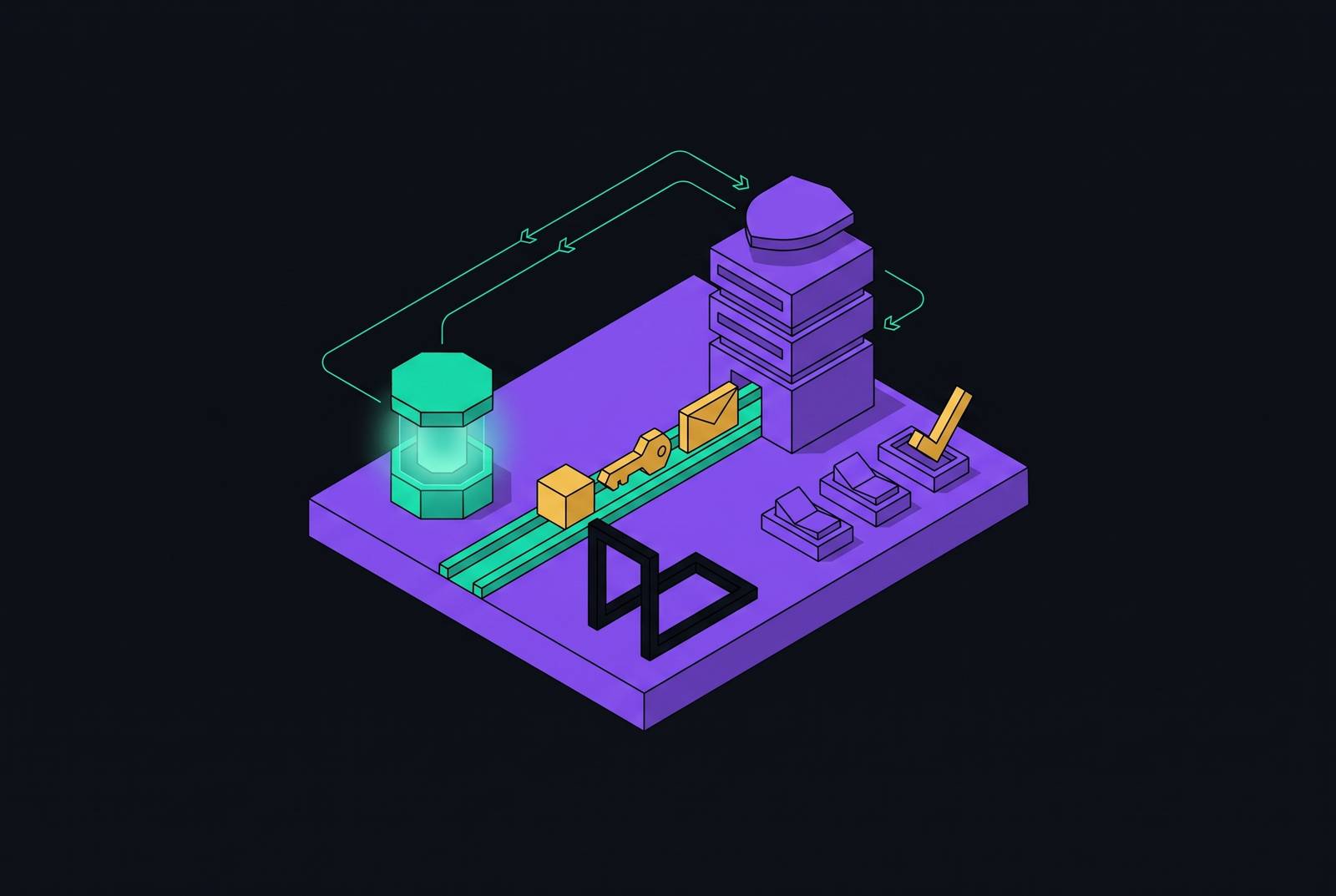
To set up a sending domain, autonomous AI agents need an explicit state machine, limits on DNS polling, and a pre-send validation gate. The agent must tell propagation delays apart from configuration errors, stop when it lacks the authority to make a fix, and keep its verification state across restarts. Autonomy comes from making those decisions programmable while retaining paths to human escalation.
Why domain verification is harder for an autonomous agent than for a human operator
Domain verification is not a single atomic event. DNS record publication, SPF validation, DKIM key confirmation, and DMARC policy alignment each produce signals at different times. Those signals may be absent, partial, or temporarily wrong. A human operator can reread an error, inspect the registrar, and decide whether waiting is reasonable. An agent has no equivalent judgment unless its implementation supplies it.
That gap is visible in the response to a DNS lookup that returns nothing. A person may interpret the result as propagation delay or evidence that publication failed. For an agent, the same result must lead to a programmatic decision, even when the available evidence does not establish the cause. The agent can wait, change the configuration, or ask for help. Choosing the wrong one can turn an ordinary delay into a stalled setup or an unsafe send.
Unattended operation amplifies the cost of that mistake. Agents can send large volumes quickly, but that speed and volume also draw attention from abuse-detection systems. An agent that begins sending prematurely can make thousands of bad sends before anyone intervenes. SPF provides a particularly sharp example of silent failure at this scale. An agent using multiple third-party sending services can exceed SPF’s DNS lookup limit without an observable error at send time, while deliverability degrades across mailbox providers.
Modeling domain verification as a state machine the agent can traverse without human input
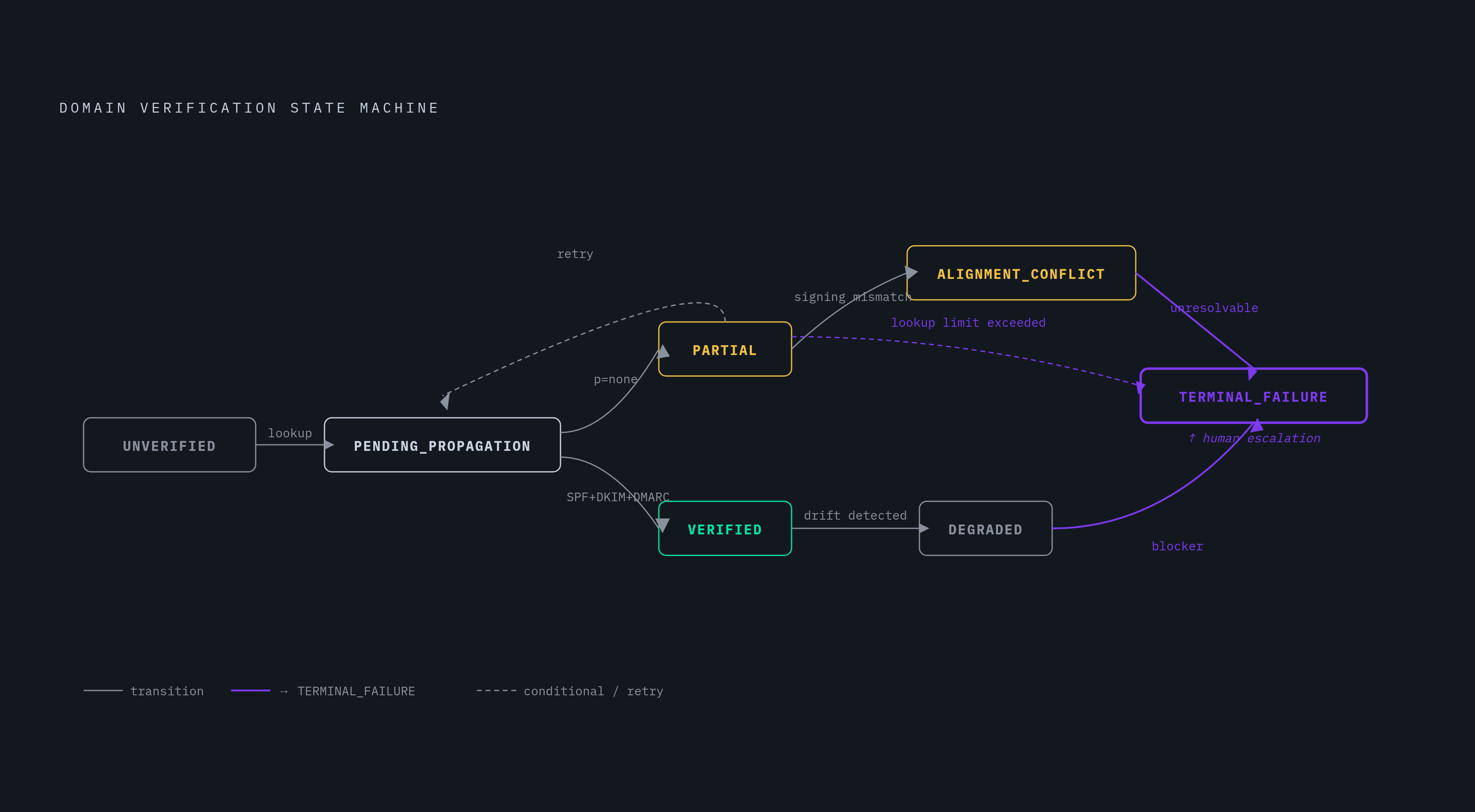
A finite set of states gives the agent a way to classify incomplete evidence without treating every uncertainty as failure. Each state needs defined entry conditions and permitted transitions. The agent can wait out a propagation delay, while a configuration conflict that persists needs a change before further checks can succeed.
The basic path begins at UNVERIFIED, where records have not been published, and moves to PENDING_PROPAGATION after publication. A successful lookup then permits a transition to PARTIAL or VERIFIED, depending on the remaining checks. PARTIAL covers incomplete configuration, such as SPF resolving while DKIM is absent. In this model, a published DMARC policy of p=none also remains PARTIAL because the readiness gate requires enforcement. VERIFIED requires SPF within the lookup limit, a valid DKIM signature, and a published, aligned DMARC policy.
The path also needs branches for conflicts and later failures. ALIGNMENT_CONFLICT identifies a signing-domain mismatch that cannot be solved by waiting. Before assigning that state, the agent must inspect the configured DMARC alignment mode, because relaxed and strict modes do not classify every domain relationship identically. DEGRADED records drift after a previous VERIFIED result. TERMINAL_FAILURE marks a blocker that the agent cannot resolve within its authority.
These states determine whether sending is permitted. They are not interchangeable labels for “setup incomplete.” Gmail and Microsoft enforcement means that bulk senders missing DKIM or DMARC can face spam-folder placement or temporary or permanent rejection. An agent that treats PARTIAL as close enough to VERIFIED therefore bypasses a substantive readiness requirement.
How the agent polls for DNS propagation without looping forever or giving up too soon
Inside PENDING_PROPAGATION, the agent needs a loop that gathers evidence, evaluates it, and either schedules another check or changes state. A fixed sleep cannot establish that propagation is complete. Visibility varies with the registrar, the previous record’s TTL, and the anycast node reached by a resolver. A timeout is not proof of absence. The agent must keep that uncertainty in mind when it decides whether to poll again.
Each cycle should query multiple geographically distributed resolvers rather than only the system resolver or one public DNS provider. The agent should leave the loop only when a quorum of those resolvers gives consistent positive results. One positive response is insufficient. It shows that the record is visible from one vantage point. Resolver diversity reduces the chance that a single stale view determines the transition.
The schedule should use exponential backoff with a cap and a maximum total wait. Initial intervals can be short, from seconds to low minutes, subject to the previous record’s TTL. The agent should record that TTL during the first cycle and use it as the floor for the first backoff interval. Later intervals expand, reducing polling traffic. Exhausting the wait budget should move the workflow to TERMINAL_FAILURE and produce a readable escalation signal.
Idempotency means resuming from the last known state rather than creating duplicate SPF or DKIM TXT records that can cause validation failures. Each verification cycle should count SPF lookups programmatically against the 10-lookup limit.
Interpreting ambiguous DKIM and DMARC signals without a human to make the call
A visible DKIM record does not establish that the sending service can use it. The agent must compare the published key material with the service’s configuration at the specified selector. Presence is only the first test. If the key exists but does not match, the problem is a configuration conflict. The workflow must require a fix, because using up its retry budget while the record stays unchanged will not make the record valid.
Selector errors make this distinction concrete. A service configured to use s1._domainkey cannot be verified by finding a key at default._domainkey. The agent must query the selector the platform specifies. Similarly, two DKIM TXT records at the same selector require record cleanup before proceeding, rather than accepting whichever result appears usable. The disambiguation protocol must distinguish an absent key, a wrong selector, conflicting records, and mismatched key material.
DMARC requires attention to policy scope as well as record presence. A sending subdomain can inherit the organizational domain’s policy, so the absence of a record directly on the subdomain does not settle the check. The agent must inspect the applicable parent policy and its sp= setting. It must then evaluate alignment under the configured mode. Sending without aligned DKIM and an enforced DMARC policy puts domain reputation at risk across sends and campaigns.
Structured errors make these distinctions actionable for software. An error can state, “DKIM key at selector s1._domainkey does not match the key on file; expected public key fingerprint abc123, found xyz789”. Pre-send linting and guardrails turn evidence into a specific decision by identifying the corrective target behind a generic “DKIM check failed” error. An absent rua= aggregate-report address deserves a separate warning rather than an enforcement failure, because its loss is reduced feedback during warm-up.
What the agent does when it reaches a state it cannot resolve on its own
Some blockers exceed the agent’s authority to repair them. Invalid registrar credentials, a locked DNS zone, or a registrar hold can prevent publication regardless of how accurately the agent diagnoses the problem. A human may also need to decide whether to remove a previous provider’s conflicting DKIM record. Likewise, the agent needs permission to soften a security team’s p=reject policy.
TERMINAL_FAILURE should produce a structured escalation that names the blocker, the missing or conflicting record, and what needs to change. Sending must remain blocked in that state. A generic free-text failure leaves the next operator to reconstruct the diagnosis, while silent continuation transfers the risk to domain reputation. VERA deals with the related problem of authority being withdrawn in multi-agent delegation graphs. Its relevance here is the principle that lost authority must be detected and surfaced, rather than answered with repeated attempts at unauthorized work.
Establishing a dedicated sending subdomain such as mail.product.example.com at setup gives the workflow a distinct boundary for pausing and escalation. A failure there need not stop the primary corporate domain or other sending streams. Isolation follows from the state model because streams managed on their own each need their own rules for when to stop.
Running pre-send validation as the final gate before the agent touches a live sending domain
VERIFIED describes the configuration at a particular check. An agent may wait hours or days before it starts its first campaign. During that gap, a sending platform can rotate a DKIM key, another tool can change SPF, or a security team can revise the parent domain’s DMARC policy. An unsubscribe endpoint can also go offline. Pre-send validation checks whether the evidence from setup still holds for the configuration used to send.
The gate should recheck SPF resolution and lookup count, DKIM presence at the correct selector and key-material match, and DMARC policy and alignment mode. Marketing sends also need validation of the List-Unsubscribe and List-Unsubscribe-Post headers. Gmail bulk sender rules require them, while Microsoft bulk sender rules recommend them. The agent must check recipients against the suppression list as it stands now. A list cleared when an audience was built is not sufficient evidence at dispatch time.
Message classification belongs in the same gate because it determines which compliance checks apply. Transactional messages such as password resets, login links, and receipts do not require an unsubscribe link under CAN-SPAM or GDPR. The FTC’s guidance says that a message whose main purpose is commercial is still commercial even when a transactional event triggers it. An onboarding sequence can cross that boundary as its content becomes promotional.
AgentSend’s guardrails layer implements this interception pattern before dispatch. It validates domain configuration and compliance requirements and returns machine-readable errors with specific fixes. That gives the agent a choice to correct parameters, escalate when authorization is needed, or suppress the send. Retries must preserve the same idempotent approach used during verification. Pre-send linting is the useful abstraction because it creates a decision point before dispatch, whereas post-send monitoring reports a consequence the agent can no longer prevent.
Keeping domain verification state current across the full sending lifecycle, not just at setup
Verification remains an operational responsibility after the first send. Scheduled DKIM rotation requires the new key to reach DNS before the old key is retired. SPF changes by other teams can invalidate a previous lookup-count calculation, while tighter DMARC policy can expose alignment failures that were previously tolerated. Domain renewal lapses can interrupt the DNS foundation itself. None of these changes requires action by the sending agent.
A lightweight periodic verification cycle should therefore compare the live DNS state with the domain’s known configuration. It is a regular drift check that can move the domain back to PARTIAL or DEGRADED and surface an escalation before the next sending cycle. The pre-send gate is still needed because periodic checks and the send happen at different times.
The agent also needs to keep track of its warm-up position after setup. An agent that pauses for weeks should treat the domain as partially warmed rather than resume immediately at its previous full volume. Putting transactional and marketing traffic on different subdomains, each with its own suppression list, likewise lets the agent respond to verification drift in one stream at a time. A DEGRADED marketing stream can pause for re-verification while login codes and receipts continue through the transactional stream. Isolation supports continuity as well as containment.
That continuity depends on a persistent state store. For each sending domain, the store should retain the last verified configuration, the timestamp of the last verification pass, and the current warm-up position. Restarts, retries, and new agent instances then inherit the context needed to interpret the next signal. The implementation boundary is clear. Verification state must belong to the sending infrastructure and persist beyond the agent session that established it.