API Contract Requirements When One Integration Must Serve Both SMTP-Style Triggers and Bulk Campaign Dispatch
A shared email API must enforce stream, retry, and reputation boundaries.
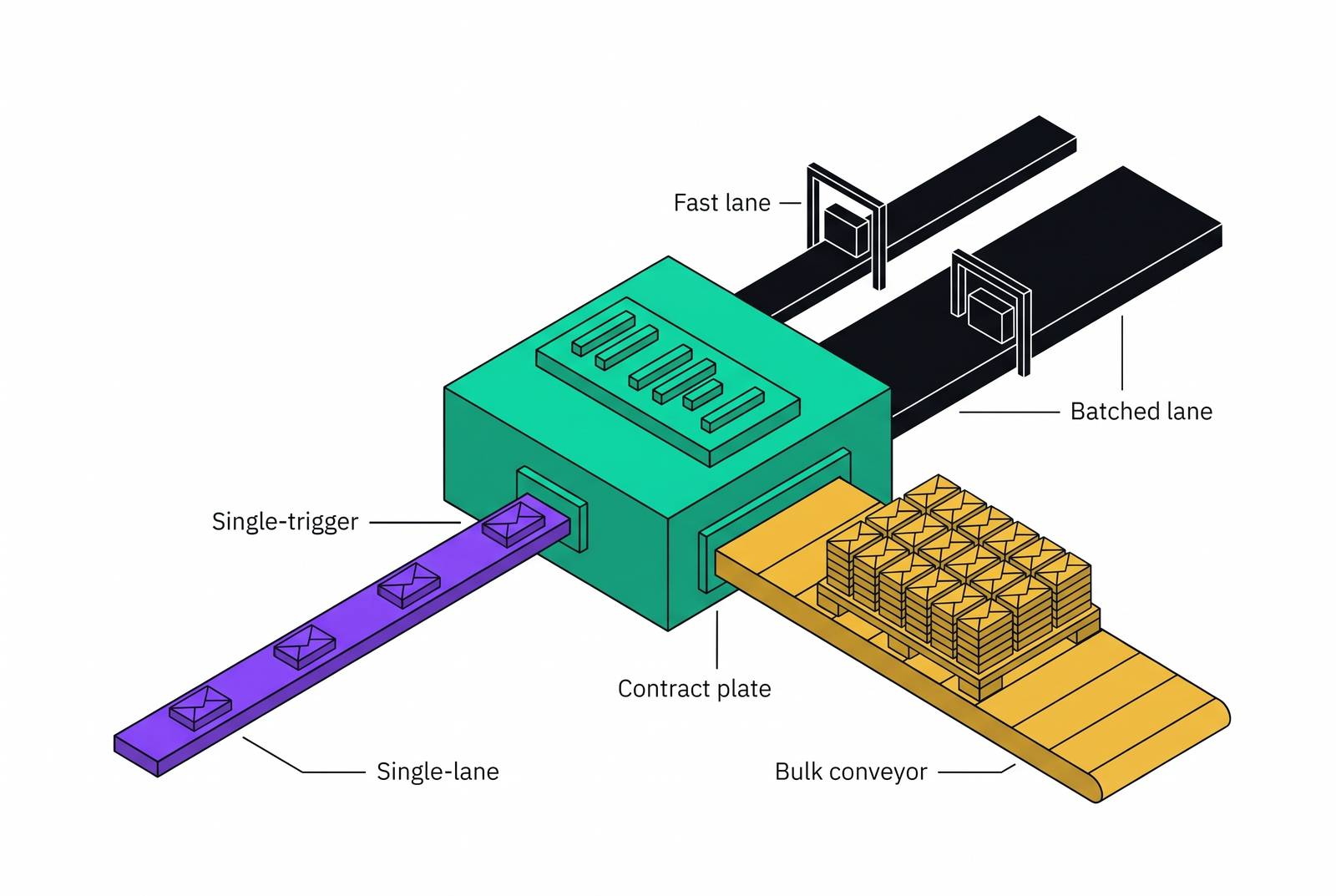
A unified transactional and marketing email API for AI applications must separate stream routing, retries, compliance enforcement, and sending reputation within one integration. Sharing an endpoint is not enough. The contract must preserve those boundaries for both event-triggered messages and autonomous campaigns, with pre-send validation and agent tool schemas enforcing the same rules.
Why a single sending integration creates a structural contract problem
A password reset may never arrive because a campaign flood has damaged the shared IP’s reputation. The reset itself can be correctly formed and promptly submitted, yet depend on a sending surface that the campaign has degraded. When account-critical sends and promotional broadcasts share infrastructure without explicit isolation, one workload can undermine the other before the application notices a delivery problem.
The underlying requirements are opposed in important ways. A transactional API sends from a domain through an SMTP relay using a single API key, but that model was not designed to hold audience state, manage consent, or pace a campaign. Bulk dispatch requires those responsibilities to become part of the sending contract. Conversely, applying transactional retry behavior to a campaign can duplicate promotional messages. A convenient wrapper therefore cannot resolve the conflict unless its contract defines how each workload behaves independently.
How the two workloads differ across every contract dimension
Stream routing is a correctness constraint. A campaign complaint rate can reach inbox providers as a signal against the domain used for account-critical messages. The API must therefore require a stream or message-type discriminator at the call site and make that field determine routing. An optional annotation cannot establish this boundary. Its absence would leave the service to choose behavior that the caller has not explicitly requested.
Transactional idempotency protects an individual send, while bulk idempotency must protect the campaign as a whole. Timing also changes the requirement. A window sized for a web request that retries within seconds may not cover an agent that wakes on a schedule, finds no record of a previous run, and submits the campaign again. Both the granularity and the window belong in the contract.
The compliance headers a message needs depend on its main purpose. The law treats transactional messages triggered by a user action differently from commercial content, and bulk promotional sends need unsubscribe mechanisms and consent handling that transactional sends do not. The contract must identify which headers each stream requires and how they are validated and enforced. Caller memory is not an enforcement mechanism.
Reputation adds an infrastructure boundary to these request-level rules. Sending reputation is scored for each domain and IP, so different labels for traffic alone cannot protect transactional delivery. The contract must define a separate sending subdomain and IP pool for each stream. This separation gives the routing field an operational consequence. Without it, two correctly classified streams can still expose account-critical messages to the effects of campaign complaints and bounces.
What the stream discriminator field must specify and enforce
The stream discriminator must be a required enum with a closed value set. A free string permits typos and unsupported values, while an optional field permits omissions that a default can silently turn into routing decisions. Neither is a sound contract boundary.
Each enum value must have documented routing consequences, including its IP pool, sending identity, compliance header set, and retry policy. A developer who reviews the API should be able to see how the chosen value leads to each of those behaviors. The same requirement applies when the caller is an agent. Even when the agent knows what kind of message it intends to send, a misconfigured default can affect thousands of inboxes before anyone notices.
How AI agents break assumptions both workloads were built on
An autonomous agent has no warm domain trust by default, and its workflow cannot assume a human review loop or a manual abort. Bulk campaign APIs were built around an operator who warms a domain, monitors complaints, and adjusts pacing. That assumption no longer holds. The volume, speed, and autonomy that make an agent useful are also signals that abuse-detection systems are trained to punish, so sending access alone is insufficient preparation for autonomous dispatch.
A scheduled run that finds no delivery record can repeat a campaign after a transactional idempotency window has expired. This execution pattern requires campaign-level duplicate protection across scheduled attempts.
Bulk fan-out introduces a further privacy risk. An API that accepts a recipient list without enforcing per-recipient variable substitution can expose the full To list to every recipient. That possibility requires validation. Rate limits must likewise be scoped per-account, per-agent, and per-domain. Suppression lists, audit logs, and complaint thresholds must be enforced by infrastructure because leaving those controls to the agent recreates the operator dependency the workflow has removed.
The pre-send linting layer as the contract's enforcement mechanism for agents
The contract must place validation between the agent’s send call and the outbound queue. Post-send monitoring comes too late to keep a malformed or non-compliant message from reaching recipients, and finding it after thousands of deliveries calls for more than ordinary debugging because compliance and deliverability are at risk. The guardrail must act before dispatch. Its role is to make the contract’s requirements hold at runtime, even when the caller generates requests autonomously.
For the campaign stream, that validation must check that the one-click List-Unsubscribe header is present and correctly formed. It must also check the recipient set against suppression state, confirm that the sending identity is the campaign subdomain rather than the transactional domain, and verify per-recipient variable substitution before fan-out. Failures must be actionable by a machine. A structured response must name the field, describe the specific problem, and supply the specific fix so the agent can correct its next attempt.
Sensitive transactional messages need a narrower content contract. Password resets, receipts, and security alerts need reviewed templates with required variables in place of free-form HTML that the agent generates for every send. Unresolved placeholders must be linting errors that block delivery. Loop protection belongs at the same boundary, with a maximum retry limit for each message and circuit-breaker conditions based on complaint or bounce rates. These conditions must halt sending access before reputation damage propagates.
AgentiSend’s guardrails layer illustrates this pre-send pattern by intercepting malformed or non-compliant sends and returning machine-readable errors with specific fixes. The relevant design choice is where enforcement sits. It is part of the sending path, rather than advice that an agent may or may not follow. That makes the pattern applicable to a unified contract without turning guardrails into a separate, optional workflow.
How the MCP schema becomes the contract's permission boundary for agentic senders
When an agent sends through an MCP server, the tool schema defines the actions available through that interface. An action absent from the schema cannot be invoked through it, regardless of instructions in a prompt. The schema is therefore a permission boundary. Tool exposure defines the requests available to the agent, while runtime validation checks each request against the sending contract.
For stream selection, the MCP definition must keep the REST contract’s required, typed enum. The agent makes its routing choice when it invokes the tool, so weakening the type there weakens the boundary before the underlying API receives the call. Discrete tools provide a further separation. A send_transactional tool and a send_campaign tool can have distinct parameter sets and required-field lists, preventing the invocation from treating the two workflows as interchangeable. The stream choice must remain consistent with the tool’s scope.
Error response shapes also belong in the tool definition. The agent needs the same named field, specific problem, and specific fix that a direct API caller receives, because a failure it cannot interpret is difficult to correct reliably. AgentiSend’s first-class MCP server makes the schema a native part of the contract and applies the same pre-send guardrails to tool calls as to direct API requests.
Compliance enforcement that must be built into the contract, not left to the developer
A campaign dispatched against a stale suppression list can reach people who unsubscribed days earlier. At bulk scale, that state error becomes a deliverability incident and an unintentional compliance violation. Agent autonomy does not remove the responsibility. Suppression checking must therefore be synchronous and pre-send, rather than depend on an agent’s remembered audience state or an asynchronous check after dispatch. The regulatory framing is per-violation.
Unsubscribe enforcement requires two distinct mechanisms. One-click List-Unsubscribe uses HTTPS, with mailto optional as a fallback, and is not equivalent to an unsubscribe link in the message body. Conflating them can cause senders to fail inbox provider checks. The campaign contract must require both the one-click mechanism and the in-body link to be added, validated, and enforced by infrastructure before dispatch. An agent generating the body cannot be relied on to preserve that distinction correctly.
The Mailfloss developer guide notes that integrations should make list status visible so bad contacts are not silently recycled into sends. For autonomous dispatch, that visibility supports a correctness requirement. The contract must also include email authentication alignment, complaint monitoring, and complaint-rate circuit breaking for the bulk stream. Monitoring alone is insufficient. When complaints cross the inbox provider’s threshold, infrastructure must halt further dispatch from that sending identity before the damage propagates to transactional delivery.
A practical contract checklist for a unified transactional and campaign API
For routing, the provider must specify a required enum with no silent default and document the identity, IP pool, headers, and retry policy selected by each value. The review should then distinguish contractual isolation from an informal naming convention. Separate subdomains and IP pools must be stated requirements, with rate limits scoped per-agent and per-domain.
Idempotency review should establish the protected object and the behavior when requests conflict. The transactional stream needs a key for each logical send, and the contract must state the window and what happens when requests conflict. The campaign stream requires protection at campaign-object granularity through a separate contract field or object type. Scheduled retries are the critical test. A provider whose guarantee covers only individual requests has not specified how it prevents an autonomous workflow from dispatching the same campaign again.
A review of validation should check which failures stop dispatch and whether the caller can fix them. Required template variables, per-recipient rendering, suppression checks, sending identity, and campaign unsubscribe mechanisms must be checked before recipients receive anything. Error responses must identify both the problem and its fix. The review should also establish the maximum retry limit and the complaint or bounce conditions that halt sending, rather than treating those controls as monitoring features with no defined consequence.
For MCP access, the same review should check for separate tools for each stream, required parameters with types, and structured error shapes. A tool path is acceptable only if it preserves the API’s validation requirements. These criteria apply to any provider, including an existing integration. AgentiSend’s guardrails and native MCP surface provide a reference for the enforcement pattern, while the full contract still needs to state the routing, idempotency, compliance, and reputation guarantees required by both workloads.