Warming a Sending Domain Used Exclusively by an AI Agent
ISPs learn AI agents through behavior patterns, not human shortcuts like trust history.
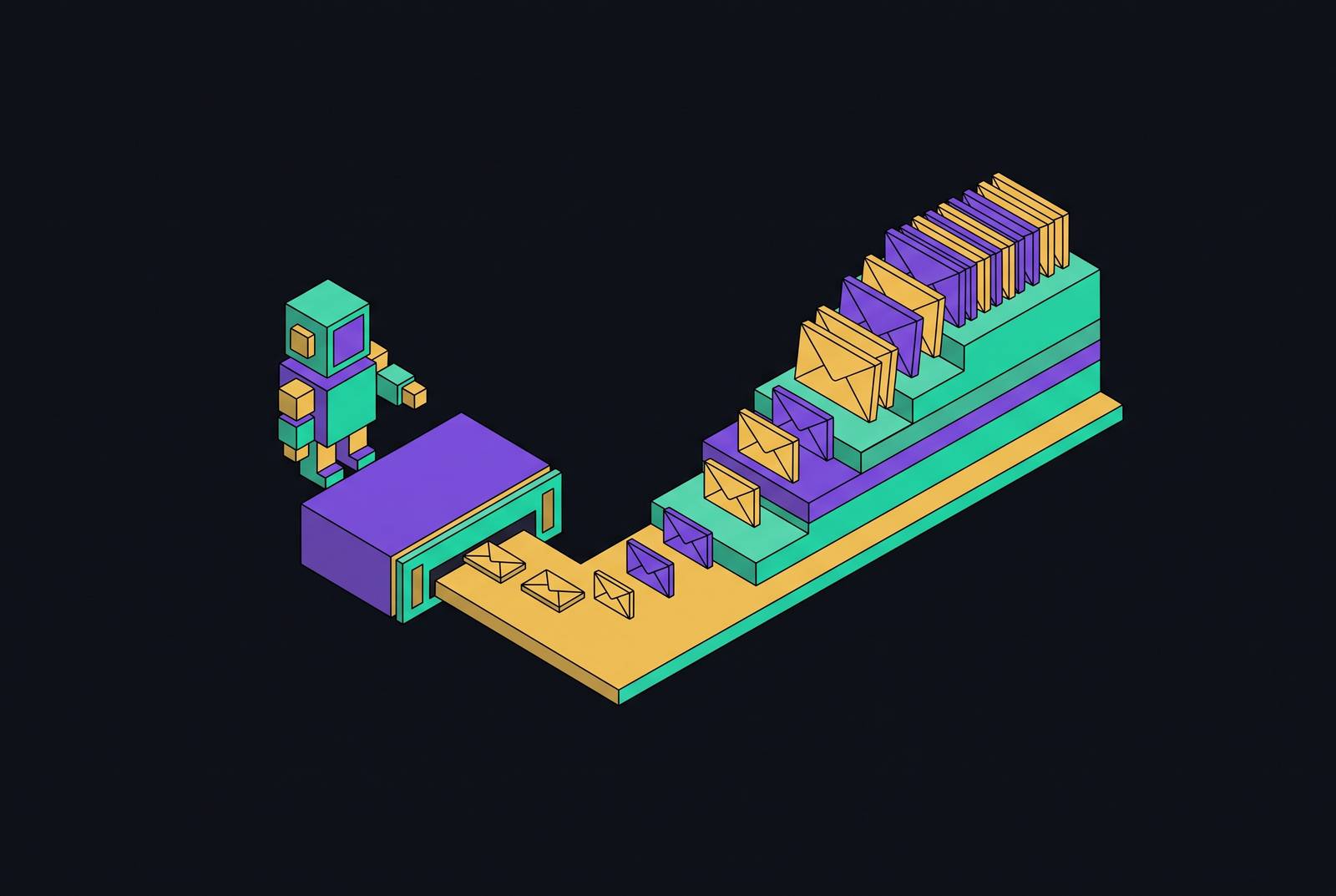
Warming a sending domain used exclusively by an AI agent requires more than a rising send count. It requires controlled sequencing, infrastructure-enforced pacing, and safeguards that stop mistakes before delivery. ISPs will learn the agent’s behavioral fingerprint, so the objective is to establish a consistent, trusted non-human pattern.
Why warming a domain that an AI agent controls is a different problem than warming one a human sends from
From an ISP’s skeptical perspective, an autonomous agent on a cold domain can look indistinguishable from a botnet until its sending pattern proves otherwise. Most warm-up guidance assumes a person manages sending, often from an established domain, at familiar times, and to people who expect to hear from it. A new agent domain has none of those shortcuts to trust. Its distinguishing risk is speed: it can send hundreds of messages in seconds, reproducing the burst pattern that throttling and blacklisting systems are designed to catch.
That speed also changes the scale of ordinary errors. A person may send a poorly targeted message to a handful of contacts, while an agent can repeat the mistake across a contact list before anyone intervenes. Content creates a separate risk. Individually composed messages can still have uniform structure and phrasing across the corpus, resembling bulk spam to mailbox filters.
What ISPs are actually measuring during the warm-up window and why agents stress each signal differently
ISPs look at bounce rate, complaint rate, and engagement during warm-up, and the patterns in content also shape how they judge messages. Agents stress these signals in distinct ways. An agent that loads a fresh contact list and immediately sends can accumulate hard bounces without the data hygiene review a human-managed campaign would typically receive. Sending to the wrong people can also lead to many complaints before anyone steps in. Because the domain has no established recipient relationships, its earliest sends need the strongest available engagement signals, including opens, replies, and marks-as-safe.
SPF, DKIM, and DMARC must be configured before sending begins. Gmail’s bulk sender rules took effect in February 2024, with full hard-rejection enforcement from November 2025, while Microsoft’s bulk sender rules took effect in May 2025. Authentication failures and complaints have different consequences. Gmail uses permanent 5.7.x rejection codes for authentication failures, while excessive complaints lead to graduated throttling and blocking. Autonomous broadcasts can quickly reach the 5,000-message-per-day bulk classification threshold, so pacing must account for that boundary from the outset.
Domain and subdomain isolation before the first send — containing the blast radius of agent mistakes
A dedicated sending domain or subdomain limits the damage an agent can cause. The main corporate domain is used for messages such as password resets, billing notifications, and security alerts. Its reputation serves more than a single campaign. A blacklisting event there can disrupt invoices and customer notifications across the company, turning an automation mistake into a wider delivery failure.
The architectural response is to leave the main domain with its existing mail host and give the agent a dedicated subdomain, such as agents.yourcompany.com. Its MX records point to the agent’s mail host, and the agent sends and receives exclusively there. The label is not the governing principle. Isolation is, with a further separation between agent-handled transactional flows and autonomous broadcasts or outreach. This allows one stream to be paused without disrupting the others.
Each subdomain still needs to go through its own warm-up. A new subdomain inherits only part of the primary domain’s sending history, though good and bad parent-domain signals can affect how providers judge it. The agent must build a reputation for each stream before sending much volume through either one.
Sequencing and pacing the volume ramp when no human is reviewing individual sends
The initial sequence should begin with a low daily send count in week one, directed exclusively to the most engaged segment of the opted-in list. Those recipients are most likely to provide positive engagement while the domain has little history. A random slice or full-list send gives the domain a less dependable starting signal, even when the total count remains small.
The prescribed ramp doubles volume each week over a four-to-eight week window, as long as inbox placement stays healthy. If placement falls below a healthy threshold, volume should decline until reputation stabilizes before the ramp resumes. Both the scheduled increases and the feedback-driven reductions must be encoded into operating parameters.
Enforcement belongs below the agent’s reasoning layer. Per-minute and per-day hard limits must constrain actual delivery, and the agent must never receive an unrestricted raw API key during warm-up. An aged-but-inactive domain also needs a warm-up pass, although positive sending history can shorten it, typically to 2–4 weeks. Its former human pattern does not establish trust in the new agent pattern. Automated warm-up systems can support reputation-building through exchanges between real accounts, but they do not replace limits on campaigns running in parallel.
Why the agent’s behavioral fingerprint is what ISPs will learn — and how to make that fingerprint trustworthy
The agent’s timing distributions, content variance, and volume profiles will remain distinct from those of a person. Warm-up instead establishes a relationship between that non-human behavior and positive recipient responses. Sending at consistent times to the same opted-in audience, with controlled content variance and steady engagement, gives providers a pattern they can recognize. Once established, sudden volume increases, content shifts, or new recipient segments can prompt re-evaluation and throttling.
An irregular upstream workflow can undermine that consistency. An agent that sometimes sends bursts at 3 a.m. and sometimes remains silent for days produces an erratic record, even if every message has a legitimate purpose. The sending schedule should therefore use fixed windows and consistent daily volumes during warm-up. Production variance can be introduced gradually after that baseline exists. The schedule governs delivery rather than simply mirroring when the upstream workflow happens to produce work.
Using the same structure and phrasing in many messages can look like bulk spam even when each message has its own personalization. Controlled differences in subject lines, preheaders, and opening lines help establish a less uniform content fingerprint. This is not a license for unrestricted generation. The purpose is a stable range of variation that remains recognizable as the sender’s normal behavior.
Pre-send guardrails that prevent a single agent error from burning the domain before warm-up completes
Monitoring after a send comes too late to stop a malformed message. An unrendered variable such as {{first_name}}, a missing compliance header, or delivery to an opted-out contact can generate complaints before a human notices. During warm-up, even a few complaints carry a lot of weight because the domain has so little reputation history. The safeguard must therefore operate before delivery. Every outbound message needs a linting layer that checks template rendering, required compliance headers, suppression status, and duplicates, then returns a machine-readable error with a specific fix.
Suppression must be deterministic and independent of the model. An agent may provision a new domain, load contacts, and start sending without checking whether those contacts opted out through another address or campaign. The platform must check suppression before each send, however the agent chose who would receive it. Otherwise, a new sending identity can skip past consent history held elsewhere.
Idempotency protects the same narrow complaint budget from retries. Approvals can be retried, callbacks can double-fire, and a transient error can cause an agent to submit the same message again. Sending duplicates close together does the most harm while reputation is still forming. Infrastructure must intercept those duplicates. Policy-as-code outside the LLM must govern send budgets, per-minute limits, approval queues above a volume threshold, and a global pause that only a human can release.
How transactional and marketing email streams should be sequenced differently during warm-up
Transactional and marketing messages should not build reputation on the same subdomain. Password resets, receipts, and confirmations follow user actions and arrive when recipients expect them, making them stronger early signal-builders. Marketing engagement is less predictable. Broadcasts are more exposed to complaints when content or timing is wrong, and they bring explicit List-Unsubscribe obligations. The transactional subdomain should therefore warm first, with the marketing subdomain introduced only after a stable transactional reputation baseline exists.
For agent-handled transactional flows, reviewed templates with required variables constrain the content to a known-good range. When used with pre-send validation, they keep unrendered variables out of sensitive messages sent to recipients. Free-form generation gives less control over what goes into those messages. Marketing needs a different safeguard because consent can change through conversation. An agent may receive “stop emailing me” while the application still records the recipient as opted in.
That disconnect is an agentic systems failure. The automation can understand a reply without propagating its meaning to the sending system, allowing later campaigns to continue against stale consent state. The systems that handle replies and suppression must therefore stay linked. Otherwise, the agent can appear responsive in conversation while its delivery workflow continues the unwanted contact. During warm-up, those repeated complaints can overwhelm the reputation the sequence was intended to build.
MCP tooling and agent-native infrastructure as the operational layer that makes agentic warm-up sustainable
A conventional email API key gives an agent access to sending while leaving the controls needed to manage reputation safely uncertain. Adding suppression, idempotency keys, inbound threading, and enforced send budgets requires substantial engineering. Warm-up is a poor time to build those controls. The domain has too little history to withstand malformed sends while the infrastructure around it is still being built. The operational layer must encode constraints as capabilities the agent can call reliably.
Model Context Protocol, or MCP, exposes account actions through a server as tools an AI assistant can call natively. In this architecture, credentials stay outside the model’s context, while the tool layer enforces idempotency and guardrails. Tool access alone is not sufficient, however. Some MCP implementations restrict email actions to drafts awaiting human confirmation, which suits reviewed workflows but does not support autonomous sending management.
AgentiSend’s MCP server provides send budgets, per-minute limits, approval queues, and a global pause that only a human can release. Inbound processing needs an equally firm boundary. Storing each processed inbound message ID in a durable store and checking it before starting an agent loop prevents delivery retries from triggering duplicate work and duplicate sends. Together, these controls let the agent operate within policy without requiring human intervention at each pacing decision.
Ongoing warm-up maintenance — what the agent must keep doing after the initial ramp completes
Automated warm-up and health monitoring must keep running during active campaigns because ISPs keep judging how the sender behaves. A sustained decline in inbox placement signals drift from the trusted pattern. Per-day and per-minute limits should therefore continue to rise gradually once reputation stabilizes. A sudden campaign expansion can otherwise undo the consistency established during the initial ramp.
List hygiene also remains a continuous obligation. A growing contact database introduces addresses that were never validated, and bounce rates above 2% are considered problematic. Complaint trends need an automatic response as well. Rising complaints should trigger volume reduction while a human investigates, and suppression must remain authoritative before every send. The enduring asset is not permission to send at any volume, but ISP trust in the specific non-human fingerprint the domain has demonstrated.