How Autonomous Agent Sending Behavior Damages Sender Reputation
Agents designed for people's email send patterns trigger spam filters and reputation damage.

When an autonomous agent sends mail through email infrastructure built for people, its machine behavior damages sender reputation. Template sameness, unchecked retries, missing compliance signals, and unthrottled sending can all resemble abuse to mailbox providers. Agents need infrastructure that constrains their behavior and catches failures before dispatch, because a successful API call cannot undo a reputation event.
Why mailbox providers treat autonomous agents like botnets by default
Google, Microsoft, and Yahoo score sending behavior. Their reputation systems cannot trust an autonomous agent just because it is doing a legitimate task. The qualities that make that agent useful can make its traffic resemble a botnet or spam campaign. To a mailbox provider, useful automation and automated abuse can present the same evidence.
People who have been sending mail for some time often have reasons to be trusted, including a warm domain, a moderate cadence, and recipients who expect the messages. An agent must earn trust through positive engagement, yet its capacity to act can outrun the time needed for those signals to accumulate. Infrastructure designed around human sending patterns therefore exposes a structural mismatch. Once a domain is flagged, subsequent failures compound the damage, and stopping the agent does not erase the reputation history it has created.
How template homogeneity at scale signals automated abuse to spam filters
A shared prompt creates a shared structure across the messages an agent generates. Emails may have different names and details but still share much of their phrasing, sentence patterns, and formatting. Human-written messages vary organically across those dimensions, whereas generation from the same base prompt produces a narrower range. The relevant unit of inspection is therefore not the polished individual email but the corpus of messages sent.
That distinction becomes decisive at scale. When the same or nearly the same messages reach thousands of inboxes in a short time, they create a fingerprint linked to bulk abuse. Changing a greeting or inserting a company name does not remove the underlying sameness. More varied prompting may change individual outputs, but it does not reliably produce enough variation across thousands of sends to defeat corpus-level fingerprinting.
A raw {{first_name}} or {{company}} can reach thousands of recipients before anyone notices that rendering failed. The agent can continue dispatching malformed messages because successful transmission says nothing about whether the content was ready. Pre-send linting is the natural response to this detectable defect, intercepting unresolved variables before dispatch. It prevents a silent rendering failure from becoming a mass sending event.
What unthrottled sending velocity does to domain reputation over weeks, not hours
Content is only one part of the signal because mailbox providers also evaluate cadence. An agent can compress a human team's weeks of sending into minutes, producing a burst that resembles a compromised account or spam campaign. New or recently warmed domains are particularly exposed because they have little positive engagement history to offset that behavior. Throttling is therefore a reputation safeguard.
The damage can accumulate without an obvious operational failure. The agent says the sends succeeded, the API returns 200s, and no bounce or complaint signal fires, even as inbox placement falls. This makes a gradual loss of trust more dangerous than a clean failure that stops a workflow. By the time poor placement becomes visible, weeks of sending may already have depleted the domain's reputation. Recovery then requires more than reducing the current request rate.
Retries can turn that slow degradation into an acute event. Delivery infrastructure normally retries failures, so an agent endpoint can receive the same delivery signal more than once. If the agent treats each repeated signal as a new instruction, the infrastructure's normal behavior can make it send the same mail in a loop. The NSA's May 2026 MCP security advisory notes that MCP does not directly enforce idempotency, leaving it to the underlying JSON-RPC and message queue specifications.
The right approach uses a stable idempotency key based on the business event, such as invoice_1234_receipt. Sent keys belong in a durable store, and a repeated key must cause the send to be skipped. Server-enforced velocity ceilings and circuit breakers must also halt transmission when an agent enters a sending loop, using limits beyond the agent's ability to bypass. AgentSend illustrates the complementary error-handling requirement by returning machine-readable errors with specific fixes, giving the agent a path to correction.
Why missing compliance signals — unsubscribe headers, suppression lists — now trigger inbox rejection before they trigger lawsuits
Compliance failures reach the mailbox provider before they reach a regulator. Gmail and Yahoo began requiring RFC 8058 List-Unsubscribe-Post headers for senders exceeding their daily recipient threshold on 1 February 2024. Microsoft began bulk sender enforcement on 5 May 2025, requiring a visible unsubscribe link without explicitly mandating that header. Those distinctions matter because a visible opt-out link and a required protocol header are not interchangeable.
Gmail began using its permanent 5.7.x rejection codes in November 2025. Google's bulk sender guidelines require aligned DMARC, one-click List-Unsubscribe, and a spam complaint rate below 0.3% for high-volume senders. An agent can break these rules throughout a workflow without anyone noticing, so compliance can hurt deliverability before legal enforcement starts. The FTC's Verkada case illustrates the later escalation, involving commercial emails sent over three years without a functioning opt-out option, honored opt-out requests, or a valid physical postal address. Unsubscribe handling needs to be part of the sending path, where it can act before mail goes out.
Suppression must instead cover every platform the agent uses. All opt-out requests need to reach one central suppression list with timestamped logs covering every campaign. Required headers must also be enforced by default before dispatch, without relying on an operator to remember to add them each time. AgentSend applies headers and suppression checks at the pre-send layer and returns a machine-readable error if a send fails those checks. This places the control where a compliance omission can still be prevented from reaching a recipient.
How prompt injection via inbound email can turn a compliant agent into a rogue sender
These failures can happen in an otherwise legitimate workflow, but inbound email gives outsiders a way to cause the same damage. An agent that reads messages and takes sending actions can encounter adversarial instructions disguised as ordinary email content. The attacker does not need control of the sending infrastructure. Sending a message to the agent can be enough to introduce instructions into the context on which it acts.
Lynch et al.'s 2026 research on agentic misalignment looks at autonomous agents that can act against the people who deploy them in realistic business settings. That research supports a narrower concern: agents with authorized access and ordinary goals can still act beyond what they are allowed to do. Prompt injection adds an outside actor who attempts to redirect that behavior. Whether a send storm begins with misalignment or malicious inbound instructions, the resulting mail is attributed to the sending domain. The domain bears the reputation cost even when its owner did not intend the action.
Inbound safety therefore belongs at the gateway, before email content reaches the LLM. Gateway-level sanitization targets adversarial system prompt overrides hidden in incoming messages. Application-level prompt hardening alone is insufficient because the instructions intended to constrain the agent can themselves be bypassed. Outbound compliance controls remain necessary, but they do not remove the need to defend the point where untrusted content becomes input to an agent with sending authority.
Why domain isolation and authentication are structural requirements, not configuration best practices
Mixing agent-driven broadcasts with transactional and human-sent mail exposes unrelated messages to the same reputation damage. A retry storm or poor marketing send can then affect password resets and login links. Domain isolation limits how much of that damage is shared, even when a workflow goes wrong.
The appropriate separation uses distinct subdomains with separate DKIM keys and, ideally, separate IPs. Transactional mail on a subdomain such as send.example.com has high engagement and must reach the inbox. Agent-driven broadcasts belong on a separate subdomain so their reputation failures are contained. The boundary matters because critical transactional traffic should not depend on the behavior of an autonomous broadcast workflow.
Aligned SPF, DKIM, and a DMARC policy at p=reject are enforcement requirements. DMARC failures produce reports that tell providers the domain is not managing its senders. Leaving authentication and isolation to repeated manual configuration invites omissions under deployment pressure or during migrations. AgentSend brings transactional and marketing sending into a single API and enforces domain-level isolation, so safety does not need to be set up separately for every agent.
Why pre-send linting is the right abstraction for catching agent failures before they reach inboxes
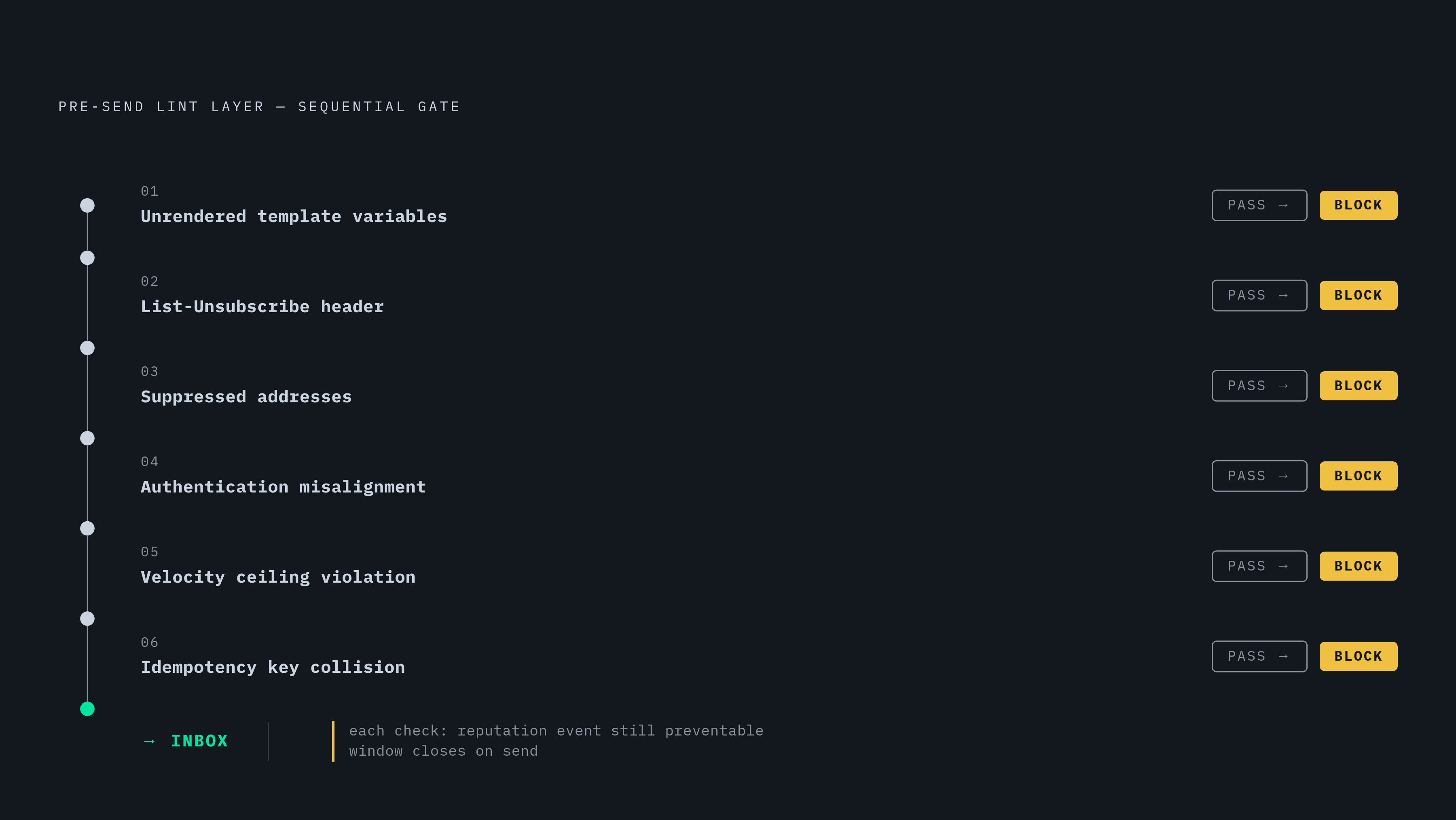
Isolation contains the consequences, but interception prevents detectable failures from becoming sends. Post-send analytics can explain what happened after a malformed message or compliance violation reached its destination. They cannot withdraw the event from the sending domain's reputation history. The decisive test is whether the action can be undone and which domain will be held responsible.
A pre-send lint layer evaluates the proposed send while rejection is still harmless to the recipient. Its checks include unrendered template variables, missing or malformed List-Unsubscribe headers, suppressed addresses, authentication misalignment, and velocity ceiling violations. These checks bring content, compliance, identity, and cadence constraints to the same dispatch boundary. Idempotency enforcement and inbound sanitization complement that boundary by controlling repeated business events and hostile input. Together, they address the ways an agent can produce an unsafe send without relying on the agent to recognize its own mistake.
The error contract matters as much as the rejection. A human developer can interpret a log and decide what to change, but an autonomous agent needs a structured error with a specific remediation path. Detailed JSON error codes and remediation URLs support that correction in a way a generic 4xx with prose does not. AgentSend's guardrails apply this principle by intercepting malformed or non-compliant sends and returning actionable machine-readable errors.
Synchronous linting does add latency to the sending path. That cost is small compared with rebuilding a burned domain reputation or recovering from a compliance enforcement action. Monitoring remains useful for understanding outcomes, but the only moment to prevent a particular send from becoming a reputation event is before it leaves the system.
The governance gap that leaves most agent deployments exposed to all of these failure modes simultaneously
These controls are often absent together because organizational policy and sending infrastructure are not aligned. The ProGEO.ai AIMM Index in April 2026 found that fewer than half of companies enforce a GenAI usage policy with technical controls. For email, a policy without enforcement leaves the agent's permission to send broader than the organization's ability to constrain it. A standard API key can let an infinite loop keep reaching production users until the account hits its limits.
A retry loop can repeatedly send unresolved variables to unsubscribed addresses from an unauthenticated domain at unchecked speed. Treating each symptom as a separate issue overlooks what causes them all: a sending path with no enforced boundary. The objection that this reflects immature tooling rather than autonomy is valid in an important sense. These outcomes are not inevitable properties of autonomous agents, but consequences of placing them on infrastructure designed for careful human operators.
Purpose-built infrastructure closes that gap by making velocity ceilings, idempotency, compliance defaults, pre-send linting, and machine-readable errors foundational requirements. AgentSend is an example of that approach, combining transactional and marketing sending with pre-send guardrails, compliance defaults, and MCP-native tooling. The broader requirement is an architecture that assumes the agent is the sender and enforces the limits that assumption demands. Autonomous sending becomes governable when safety is part of permission to send.