Routing Logic Agents Must Own When One Email API Handles Both Send Types
Agents must classify every message and isolate send streams before the API accepts the call.

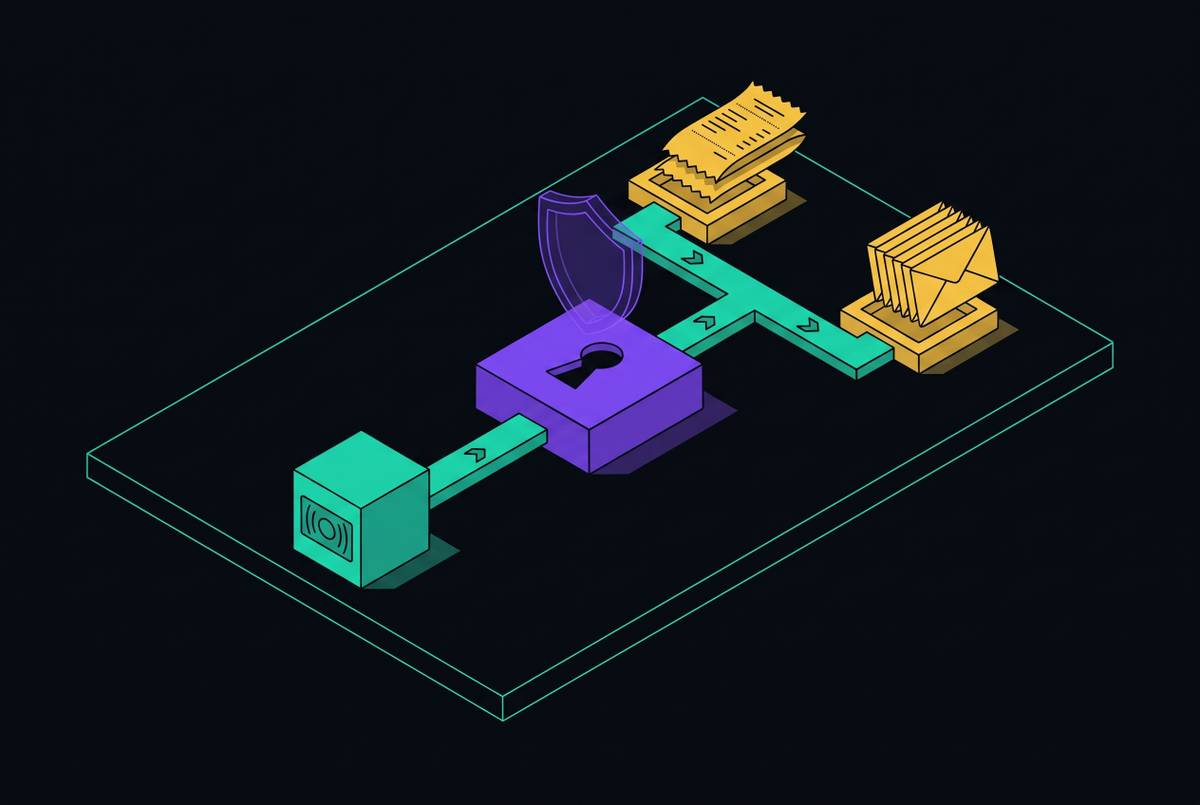
A unified transactional and marketing email API for AI applications lets an agent send receipts and newsletters through the same platform. It does not separate their risks automatically. The agent must classify each message, isolate its sending stream, and enforce suppression and compliance before dispatch.
Why one API for receipts and newsletters relocates the routing problem
“One API for everything” presents a deceptively simple architecture. Transactional email follows a single user action and goes to one recipient, while marketing email broadcasts to a list. Both can pass through the same interface. Yet they have different legal obligations, deliverability signals, and failure modes, none of which disappear when the transport is unified.
Conventional email service providers can support both send types without enforcing infrastructure separation by default. A permissive configuration therefore allows mixed streams and shared reputation even when the application treats the messages as distinct. The API can accept a request without establishing that it belongs on the chosen stream. Acceptance is not a routing guarantee.
A human operator can notice this gap in a dashboard and configure around it. An autonomous agent has no equivalent dashboard workflow on which the architecture can safely depend. Its routing decisions must already be encoded when sending begins, rather than discovered during deployment or after a complaint spike. Unification transfers responsibility to the agent calling the API.
How misclassification produces deliverability damage that arrives silently
A marketing broadcast routed through the transactional stream exposes password resets to the broadcast’s complaint signals. When the messages share a sending domain or IP, a poorly performing campaign can degrade the reputation on which necessary account messages depend. The recipient’s need for a password reset does not protect that message from the shared stream’s history. The boundary has already failed by the time filtering can be seen.
This damage need not produce an API rejection or bounce. A message can reach the spam folder or be deprioritized without a machine-readable signal that tells the agent its routing decision was wrong. The send path appears healthy while its reputation deteriorates.
Agents accelerate that mismatch between action and feedback. They can classify and dispatch faster than a human operator, allowing a flawed route to reach scale before monitoring exposes the effect. More sends then follow the same path while earlier mistakes harm its reputation. Post-send monitoring is structurally too late to be the primary safeguard for autonomous sending.
The classification decision the agent must make before every API call
The first control belongs inside the agent’s send path. Every outbound message must be classified as transactional or commercial before the API call, because the API will not refuse a message merely because the caller assigned the wrong category. A transactional message follows one user action, while a commercial message is sent for a marketing purpose. That distinction governs more than template selection.
CAN-SPAM applies to any “commercial electronic message” sent to US recipients. Transactional messages receive exemptions from some requirements, but not all, so the transactional label cannot function as a blanket exemption from compliance. The agent must own this boundary explicitly. A code comment about how a tool should be used does not enforce the legal distinction when a tool call is put together.
A practical implementation makes 'transactional' | 'commercial' the required first argument of a single send path. Downstream routing and validation then branch on that value. If the argument is optional, there is no guarantee that classification took place, and if its value is accepted without checking the content, misclassification is still possible. Classification also selects the relevant suppression gate, whose failure must prevent dispatch rather than become a warning attached to an otherwise valid request.
Stream isolation at the infrastructure layer — subdomains, IPs, and what the agent must provision
A correct classification does not isolate reputation by itself. If both branches still select the same sending domain and IP pool, marketing complaints can contaminate the transactional stream despite the distinction in code. The agent must check the sending identity and infrastructure it has chosen as well as attach a category to the request.
Agents should at least use a separate subdomain for each send type. A dedicated transactional subdomain and a distinct subdomain for autonomously drafted messages separate their reputation signals at the DNS level. The IP pool remains part of the isolation decision because shared IP reputation can still connect otherwise distinct routes.
Agent-generated content adds another reason for that separation. Its higher variance creates more unpredictability than hand-written email, and that variability should not reach the transactional stream. Provisioning must also cover domain authentication, DKIM records, verified sender identities, and onboarding errors. Where a conventional provider expects a human to complete those steps, an agent-ready platform automates them so a provisioning script can establish the sending identity without human intervention.
Suppression list enforcement as a hard pre-send gate, not a soft check
Suppression is a separate obligation from message classification. For commercial sends it is a legal requirement, while its enforcement also protects the complaint rates that affect transactional delivery. The suppression list must exist and be readable before the first commercial message leaves the system. Building it reactively after complaints arrive cannot undo reputation damage already recorded.
The gate must fail closed for commercial sends. A suppressed recipient produces a refusal without an API call, and an unreadable list produces an error and no send. That behavior must hold whether the cause is a network error, a permissions failure, or a cold start. Treating unavailable suppression data as an empty list substitutes optimism for enforcement.
Retries create a second risk at the same gate. Suppression blocks prohibited recipients, but it does not prevent duplicate messages to recipients who remain eligible. The agent must therefore supply an idempotency key derived from the business event, such as invoice_1234_receipt, and shared across individual requests for that event. A retried tool call, a repeated agent step, and a webhook redelivery can then collapse to one send.
Marketing compliance obligations the agent must enforce on every commercial send
When a message is classified as commercial, it must be checked for compliance before dispatch. The platform’s ability to support unsubscribe headers does not establish that the agent attached them, and an unsubscribe link in the body does not replace the provider-facing mechanism. Both mechanisms must be present where required.
RFC 8058 one-click unsubscribe headers are mandatory for senders above the volume threshold sending to Gmail or Yahoo consumer inboxes. The message needs List-Unsubscribe containing an HTTPS URL and List-Unsubscribe-Post with the value List-Unsubscribe=One-Click. Those headers must connect to a functioning endpoint. Their presence alone does not establish that an unsubscribe request will succeed.
An endpoint that returns a confirmation page requiring another click fails the one-click requirement. A redirect chain or click tracker can strip the POST body, while an endpoint accepting only GET cannot process the provider’s POST request. These are silent mechanical failures. The agent must guard against them rather than infer correctness from a link that opens in a browser.
Gmail and Yahoo set a two-day processing expectation for high-volume senders, making that the binding constraint for most senders, ahead of CAN-SPAM’s ten-business-day legal window. An agent that waits for the longer deadline can break inbox-provider requirements before the legal deadline arrives. Functioning unsubscribe mechanisms also reduce spam complaints, which inbox providers use as a primary signal for routing future messages. A broken opt-out path is therefore a deliverability defect as well as a compliance defect.
Pre-send linting as the correct abstraction for catching routing errors before they reach inboxes
These controls belong in a pre-send lint layer that intercepts every outbound message before the API call. The layer checks the routing rules, the suppression state, how authentication is set up, and whether commercial sends meet compliance requirements. Monitoring remains useful, but it cannot retract thousands of messages sent through a flawed path before a reputation signal changes.
Linting must check the message that was put together as well as what the caller says it intends to send. Its checks should catch unrendered template variables, missing commercial unsubscribe headers, suppressed addresses missed earlier, and mismatches between the From-header domain and the DKIM signature. It must also catch commercial content routed as transactional.
Failures need typed, machine-readable errors that say how to fix them. An ambiguous error string leaves the agent to infer a recovery path, creating the risk of a hallucinated retry. The four-layer guardrail framework places least privilege and isolated credentials at the access layer, with permissioned contacts, suppression enforcement, and size limits at the audience layer. Approval covers a stable preview, test send, and confirmed delivery payload, while operations covers audit logs, stop controls, and post-send review for drift. Pre-send linting sits at the audience and approval layers and runs on every send.
AgentiSend’s guardrails provide a concrete implementation of this design. Its pre-send checks for budget, loop guard, suppression, and trust use the same code path through POST /emails/preflight, while its 4xx/5xx refusals include a fix field naming the endpoint to call next. The architectural distinction is the placement of validation before dispatch.
MCP tooling and what native protocol support changes about routing reliability
The calling interface determines how reliably the agent can execute these controls. With a hand-rolled wrapper, the developer has to provide type guarantees, handle idempotency, and build structured error paths. Native tooling cuts the work needed to build custom adapters for operations that routing depends on. It does not, however, remove the need to inspect which guarantees the protocol and implementation actually provide.
Anthropic introduced the Model Context Protocol in late 2024 to let AI assistants connect to external tools and data. An email MCP server exposes capabilities through one connection to MCP-aware clients. Stable, typed tool definitions make it clearer which arguments are required and what responses a failure will return. However, MCP does not directly enforce idempotency, so the agent must still supply the business-event key on every write.
Authorization also needs explicit handling through OAuth 2.1 with PKCE and scopes limited to the operations the agent needs. Dynamic Client Registration is optional, and the 2026-07-28 specification deprecated it in favour of Client ID Metadata Documents. Machine-parseable failures use 429 for quota errors, 401 for missing tokens, and 403 for wrong scopes. Those distinctions let the agent separate authorization failures from sending failures instead of treating every refusal as a reason to retry.
The same product provides a native MCP server with typed definitions for classifying sends, checking suppression, attaching compliance headers, and reading lint errors. Responsibility for choosing the right route remains with the agent.
The reputation model agents are now operating in and why old calibration is wrong
The current deliverability environment adds authentication checks, reputation signals, and AI-powered relevance scoring to the path toward an inbox. Failures can result in gateway rejection or spam-folder placement with a possible second chance. The agent’s controls must address both misrouted messages that are accepted and defective sends that cannot pass the receiving boundary.
Google stopped using the High/Medium/Low/Bad labels for domain and IP reputation in Postmaster Tools and moved senders toward a view based on compliance. That view shows Pass / Needs Work per requirement, later supplemented by a Deliverability Analysis verdict. An agent calibrated to the old graded labels cannot depend on that feedback structure. Mostly correct routing does not compensate for a failed requirement, and reputation damage need not wait for a warning.
Purpose-built agentic email infrastructure is consequently a deliverability decision as well as an interface preference. Conventional APIs and retrofitted wrappers can leave judgments to human operators who read dashboards, interpret ambiguous errors, and notice unusual behavior. An autonomous send path needs explicit engineering controls in place of that judgment. The agent (not the platform) must own classification, stream isolation, suppression, compliance headers, pre-send linting, and idempotency, because each is a decision point where “the platform will handle it” leaves an enforcement gap.