Sending Domain Setup for AI Agent Applications
Protect business email by isolating autonomous agents on dedicated subdomains.

Sending domain setup for an AI agent follows the same DNS fundamentals as any other email program, but three decisions carry different weight once the sender is autonomous: which domain or subdomain the agent sends from, how authentication records are scoped to that sender identity, and how domain verification completes without a person in the loop.
If a human operator sees bounce rates climb or a domain get flagged, they will stop and investigate. Every section that follows exists to close that gap before the agent sends its first message.
The blast-radius problem: why agents must not send from a primary domain
If an agent shares a primary domain with the rest of a company's email program, what it does can put every message the business sends at risk. ISPs score sender reputation at the domain level, so complaints, bounces, or spam-trap hits the agent generates on yourcompany.com attach to that domain's reputation, and the next password reset or invoice notification sent from the same address inherits the damage.
Domain reputation builds over weeks of consistent, well-received sending, but it can be destroyed in hours. When an agent fires a large burst of messages from a cold primary domain, you get the volume-and-reputation mismatch that triggers ISP throttling and blacklisting. Repetitive phrasing, templated sentence structures, and the unusual word distributions typical of generated text can draw closer scrutiny from spam filters, so when content signals alone leave a filter uncertain, domain and IP reputation becomes the backstop a sender relies on.
Developers often dismiss this risk by pointing out that their agent only sends a handful of emails today. The decision to isolate the agent's sending identity has to be made before volume arrives, not after a reputation problem forces the issue.
Choosing the right sending domain structure: subdomain vs. separate domain
Agents must not send from a primary domain, and the architectural question that follows is what to send from instead. Three structures are available, and they differ sharply in how much isolation they provide and how much setup they demand.
| Structure | Isolation | Setup requirement | Best fit | |---|---|---|---| | Primary domain | None, agent shares reputation with all business email | Minimal | Internal prototypes and non-production testing only | | Dedicated subdomain | Full, independent reputation envelope | Three DNS records on the new subdomain | Recommended default for production agents and customer-facing email | | Separate domain | Complete | Domain purchase, full DNS setup, and warming | High-volume dedicated sending programs or regulated industries with strict segregation requirements |
The subdomain path costs almost nothing extra to configure against the reputation protection it buys, so it is the right starting point for most agent deployments. If your team is building an agent that sends order confirmations, onboarding sequences, or support replies, the subdomain works and is usually all you need.
The three DNS records every agent sending domain requires
Once the subdomain is chosen, three DNS records are mandatory before the agent sends a single message: an SPF TXT record, a DKIM record, and a DMARC TXT record, each scoped specifically to the sending subdomain.
SPF (Sender Policy Framework)
SPF is a TXT record published on the sending subdomain that lists which mail servers are authorized to send on its behalf. A minimal example looks like:
agent.yourdomain.com. TXT "v=spf1 include:_spf.yourprovider.com -all"
For an agent, that record should be scoped to the specific email service the agent sends through, not inherited or copied from the primary domain's SPF record. Reusing the parent record creates ambiguity about which sends it actually covers and weakens the isolation the subdomain is meant to provide. SPF alone will not get a message delivered reliably: Gmail and the other major providers require all three records working together before they treat a sender as trustworthy.
DKIM (DomainKeys Identified Mail)
DKIM is a TXT record, sometimes delivered as a CNAME that points to a provider-hosted TXT record, that lets the sending platform attach a cryptographic signature to outgoing messages. Receiving servers use that signature to confirm the message was not altered in transit. A representative record resembles:
selector._domainkey.agent.yourdomain.com. TXT "v=DKIM1; k=rsa; p=MIIBIjANBgkqhkiG9w0BAQEFAAOCAQ8AMIIBCgKCAQEA..."
Some providers rotate DKIM keys automatically on a fixed schedule, but others leave it to the operator. Scoping DKIM to the sending subdomain means a key compromise or a rotation error on the agent's subdomain has no effect on signing for the primary domain.
DMARC (Domain-based Message Authentication, Reporting and Conformance)
DMARC is a TXT record published at _dmarc.agent.yourdomain.com that tells receiving servers what to do when a message fails SPF or DKIM alignment, and where to send aggregate reports about those failures. A starting record looks like:
_dmarc.agent.yourdomain.com.
DMARC alignment requires that the domain in the From header match either the SPF-authorized domain or the DKIM signing domain. For a subdomain sender, that alignment needs to be checked explicitly rather than assumed to work by default. Gmail's enforcement policy for senders of high daily volume to personal accounts requires aligned DMARC, and enforcement now produces both temporary and permanent rejections rather than soft errors alone, so a misconfigured record on an agent's subdomain can now generate hard bounces instead of warnings.

## Programmatic domain verification: what changes when no human is watching

Conventional domain verification assumes a person logs into a DNS panel, pastes in the records, and clicks "verify" inside an email service's dashboard. When the agent is the operator, that assumption no longer holds, and the entire verification loop needs to run through an API or CLI from the first step.

When agents operate without human review, they can run into failure modes that conventional email infrastructure was never built to handle. Purpose-built email infrastructure for agents, like GIC - Agent Send, embeds pre-send guardrails that lint domain configuration and authentication records before the agent dispatches a message, catching setup errors before they damage sender reputation at scale.

A workable automated verification loop follows a consistent sequence: register the sending subdomain through the API, retrieve the required DNS record values from the API response rather than hardcoding them (since key selectors and include targets vary by provider), add those records to the DNS zone programmatically through the registrar's API or infrastructure-as-code, and then poll the verification endpoint until SPF, DKIM, and DMARC all pass. Any send permission granted to the agent should be gated on a confirmed-verified status returned by the API, never inferred from how much time has elapsed since the records were created.

Since agents cannot pause to troubleshoot DNS misconfigurations the way humans can, every record must be validated programmatically before the agent sends, a constraint that separates agent-ready email platforms from general-purpose email APIs built around the assumption that a developer will manually verify each DNS change in a staging environment. AgentiSend's API returns machine-readable verification status per record, which lets an orchestrator gate the agent's send permission on that verified status without routing the decision through a human reviewer. That is the correct abstraction for automated domain onboarding: verification as a structured status an agent can poll and act on, not a dashboard screen only a person can read.

## Warming a new sending subdomain before the agent sends at volume

A new subdomain carries no sender reputation on day one, and sudden volume from a domain with no history is one of the most reliable triggers for ISP throttling and blacklisting, regardless of how correctly its DNS records are configured. Warming the subdomain, meaning a gradual increase in send volume over a period of weeks rather than an immediate jump to full scale, is the standard path to establishing a positive sender score on any new domain or subdomain.

For an agent, warm-up carries an added dimension beyond volume. Practically, that means sending to the most engaged recipients first, the ones most likely to open a message and least likely to mark it as spam, and holding the agent to hard daily caps it cannot override during the ramp. You should lift those caps only when deliverability metrics confirm the subdomain's reputation is established.

You need to watch bounce rates, spam complaint rates, and DMARC aggregate reports closely all through the warm-up period. A subdomain that skips proper warm-up reaches that threshold faster than most developers expect, often before the reputation needed to survive it has had time to form.

## Compliance records the agent cannot be allowed to skip: List-Unsubscribe and suppression

A sending subdomain can be fully authenticated and properly warmed, and the operator can still face regulatory liability if the agent sends marketing email without one-click unsubscribe headers and a suppression check that runs in real time. Authentication and warm-up solve the deliverability problem; they do nothing for the compliance problem, which sits on a separate layer entirely.

One-click List-Unsubscribe functions as infrastructure now, not an optional nicety. RFC 8058 specifies a List-Unsubscribe-Post header that lets a recipient opt out without opening a webpage or signing into an account, and Gmail surfaces this mechanism as a native "Unsubscribe" button placed next to the sender's name. For an agent sender, generating correct List-Unsubscribe and List-Unsubscribe-Post headers has to happen at the infrastructure level, so it can't be left to the agent to construct per message. An agent that omits or malforms that header on a broadcast turns a single mistake into a compliance failure at scale.

Suppression lists demand the same real-time discipline. The suppression check belongs at send time, not at the moment a campaign is built: an agent that caches a recipient list at the start of a run and never re-validates it against the suppression list before each individual send leaves exactly that gap open.

These requirements carry real regulatory exposure, and how much depends on the jurisdiction. None of these frameworks recognizes "the agent did it" as a defense. The consent models differ as well: CAN-SPAM permits sending first and letting recipients opt out afterward, while GDPR requires affirmative consent before any send at all, and CASL requires either express or implied consent before sending. AgentSend enforces List-Unsubscribe headers and suppression checks by default at the infrastructure level, so the agent cannot dispatch a broadcast without them, which is the right place to enforce compliance rather than relying on instructions buried in a prompt.

## Pre-send linting: catching malformed sends before they reach the inbox

The most dangerous failure mode for an agent sender is the one nobody notices until it has already happened: an unrendered template variable, a missing unsubscribe link, or a malformed header that reaches thousands of inboxes before anyone catches the mistake. Autonomous agents have no equivalent checkpoint, so you have to build one directly into the sending infrastructure.

The right abstraction here is a pre-send linting layer that sits below the agent rather than inside it. The agent builds and submits the message, and the linter intercepts it before delivery, no matter what the agent's own logic or prompt instructions say it should do. A check placed in the sending path itself is a refusal the agent cannot bypass, and that distinction is what separates a guideline from a guarantee.

A linter operating at this layer should catch unrendered template variables, the literal {{first_name}} or {{ order_id }} that occasionally survives into a message body or subject line; missing or malformed List-Unsubscribe and List-Unsubscribe-Post headers on marketing sends; recipients who are present on the suppression list at send time; missing required headers such as From, To, or Subject, or headers that would fail DMARC alignment; and content patterns suggesting the message is destined for an unverified or cold recipient list, a common signature of cold email abuse. The error response needs to be machine-readable, returning a structured error with a specific field and a suggested fix, so the agent or its orchestrator can act on the failure programmatically instead of leaving a log entry only a human will eventually read. AgentSend's guardrails layer implements exactly this pattern: every send passes through pre-send linting, and any malformed or non-compliant message returns a machine-readable error with a specific fix before it ever reaches a recipient.

## Idempotency and retry safety: preventing duplicate sends in autonomous workflows

If an agent treats a send timeout as proof the message was never sent, it will retry, and if the original attempt actually succeeded, the recipient gets the same message twice. This failure mode is unique to autonomous systems, because a human watching the process would recognize the ambiguity and check before resending.

The fix is an idempotency key attached to every send operation, generated by the orchestrator rather than by the model itself. The key has to be passed to the sending API, and the API must use it to deduplicate at the infrastructure level rather than leaving that logic to the application layer, where it is easier to miss.

Inbound messages introduce a parallel version of the same problem. Storing the message_id of each processed inbound message in a durable store, and checking it before initiating any agent loop, prevents an agent from launching a fresh response cycle every time the same message is redelivered, a mistake that duplicates sends and corrupts the state of the underlying conversation thread.

A subtler edge case appears around the idempotency key's expiration window. The key's time-to-live needs to exceed the longest realistic retry interval the system might encounter, or the protection it provides disappears exactly when a delayed retry needs it most.

## Staged access: giving an agent send permission incrementally, not all at once

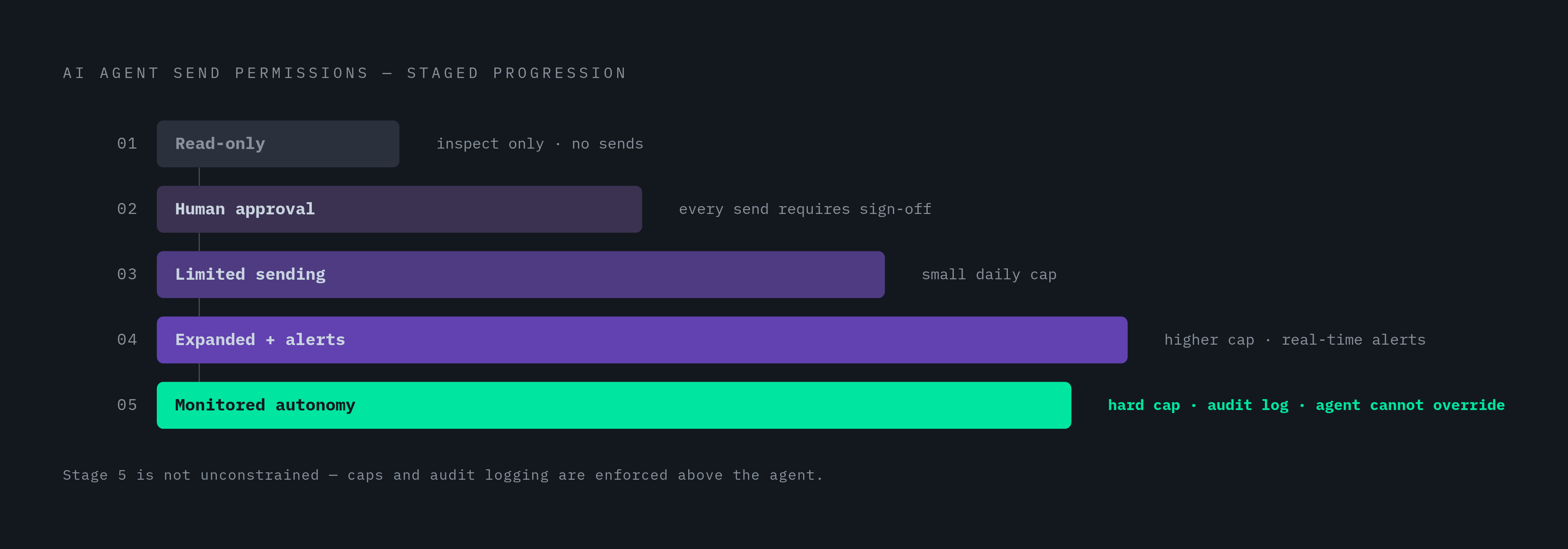
A domain that is isolated, authenticated, warmed, and protected by pre-send linting is still at risk if an agent receives unrestricted production send access before anyone has observed how it actually behaves. The safer path is staged access, where permission expands only as the agent demonstrates it deserves more.

The first stage is read-only access, where the agent can inspect subscribers, campaigns, and delivery stats but cannot send or modify anything. The fifth is monitored autonomy: full send access, governed by hard daily caps the agent cannot modify, real-time alerts on complaint and bounce rate thresholds, and a complete audit log of every send decision the agent makes.

That audit record should capture, at minimum, the agent ID, the specific agent execution ID that triggered the send, the message ID, the recipient address, the send timestamp, the exact tool call parameters the model provided, the governance decision reached (allowed or blocked, and why), and the resulting delivery status. The human-in-the-loop approval stage is not meant to be permanent. It works as a confidence-building phase, so the operator can see how the agent actually behaves before the approval gate comes off. AgentSend's per-send guardrails and machine-readable audit trail are built to support exactly this progression: the same API serves all five stages, and you can configure caps and approval gates per sending domain instead of standing up separate infrastructure at each step.

A domain built through this sequence, isolated on its own subdomain, authenticated with SPF, DKIM, and DMARC scoped correctly, verified programmatically, warmed before volume, compliant on unsubscribe and suppression, protected by pre-send linting, safe against duplicate sends, and opened to the agent incrementally rather than all at once, is a domain ready to hand an agent its sending keys without putting sender reputation at risk.