Domain Pool Architecture for Agents That Spin Up Sending Identity at Runtime
Agents need authenticated sending identities that provision dynamically, not at deployment.

Sending domain setup for autonomous AI agents requires a managed pool of authenticated, pre-warmed identities that agents can claim at runtime. Domain pool architecture makes that possible by placing DNS provisioning, reputation management, and send enforcement under infrastructure control. Its central requirement is isolation, so one agent’s failure does not compromise every sender.
Why agents need sending identities provisioned at runtime, not preconfigured at deploy time
Conventional email infrastructure assumes a human operator configures sending domains at deployment and reuses them indefinitely. Autonomous agents break that assumption because they instantiate, execute, and retire workflows dynamically, often without human intervention. Deployment no longer determines the full identity inventory. An agent handling isolated tasks for many tenants needs authenticated identities that can be assigned programmatically, without manual DNS changes or account creation whenever a workflow starts.
A shared mailbox does not resolve that gap. Early architectures used addresses such as support@company.com or ops@company.com, with multiple worker agents polling IMAP. Under production load, this setup causes state serialization failures, races over who owns a message, and duplicate tool calls. A common address joins workloads whose execution state needs to remain separate.
SPF, DKIM, and DMARC encode sender legitimacy at the domain level, so an address alone cannot establish authenticated sending. Agents can also send as fast as machines allow without anyone correcting them. A misconfigured or looping agent can exhaust a domain’s reputation before an operator notices, exposing every other sender that shares it.
What domain pool architecture actually is, and what problem it is solving
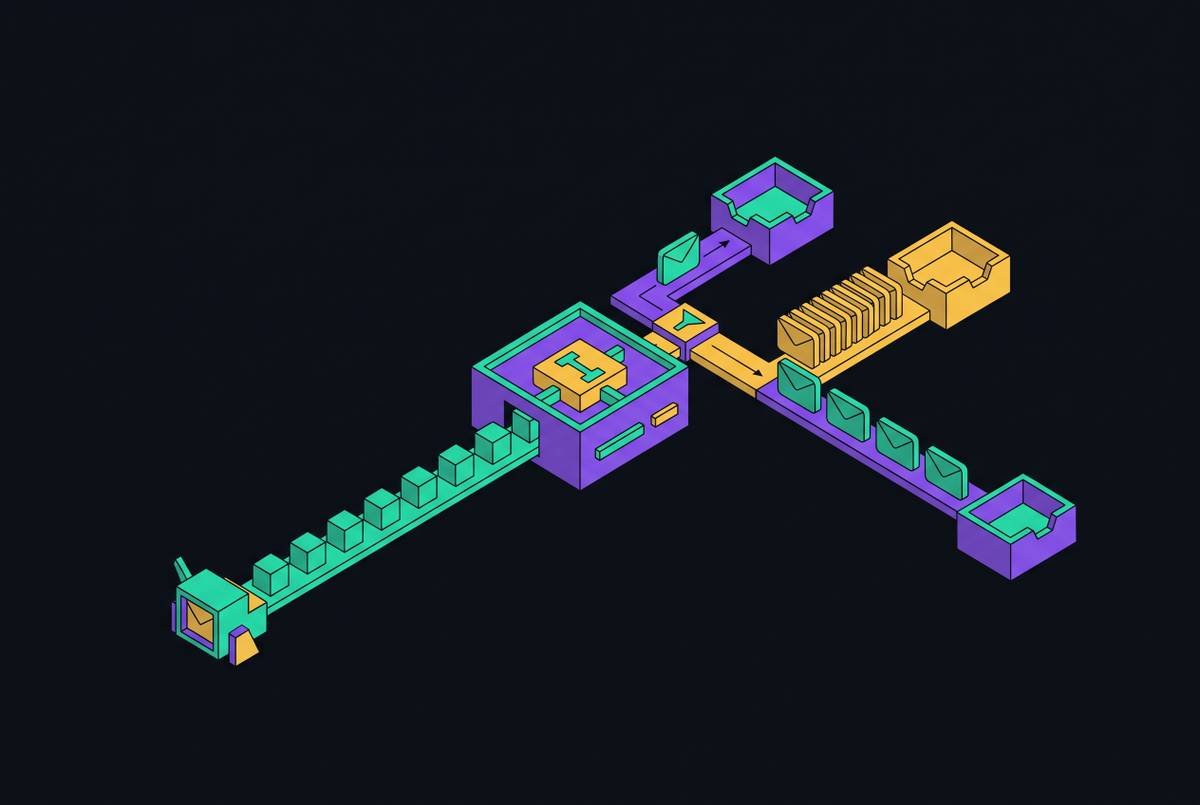
A domain pool is a managed inventory of pre-authenticated sending domains or subdomains held in reserve for runtime assignment. For product and opted-in marketing email, it separates identity preparation from the moment an agent needs to send. The runtime claims an eligible identity from inventory. It does not wait for DNS propagation and reputation building as part of the task itself.
Reputation isolation determines the pool’s structure. When agents share a domain, one agent’s high bounce rate, complaints, or retry loop can degrade delivery for the others. A dedicated subdomain such as agents.yourdomain.com keeps what agents send separate from activity on the primary domain. However, subdomains still share the parent domain’s overall reputation signal, so that separation is not equivalent to using independently registered domains.
Unlike a static multi-domain setup, it assigns identities dynamically rather than mapping them to fixed roles at deployment. It also replenishes inventory as identities leave service. Warming prepares identities for assignment, while rotation moves workloads away from domains that should no longer send.
How to size a domain pool for unpredictable agent workloads
Pool sizing starts with peak identity demand. Expected concurrency sets how many tasks or tenants need isolated identities at the same time. Two workloads with similar send totals can therefore need different inventories if their isolation requirements differ. The pool must absorb workload variance without accumulating more domains than its rotation and monitoring systems can manage.
A warm-up runway of roughly two to four weeks, compressed with automated tooling, must be included in replenishment planning. Domains that leave service need replacements before the pool runs out of available inventory. The sizing model must allow for the retirement rate and how long replacements take to finish warming. Burst headroom can include partially warmed reserves, but those identities can absorb demand only at reduced volume.
A unique agent subdomain under agents.yourdomain.com keeps DNS management within a single registrar account, but retains the shared parent reputation signal. Separate registered domains offer stronger separation but cost more to manage. For most agentic workloads, subdomain isolation under a dedicated agent-sending domain that is separate from the primary product domain strikes a balance between isolation and cost. That choice establishes the unit the pool must provision, monitor, and replace.
How do you configure sending-domain DNS for an agent without human intervention?
Manual DNS configuration prevents genuinely on-demand identity provisioning. SPF, DKIM, and DMARC records must exist before a new domain sends, while propagation introduces delay between requesting an identity and using it reliably. DNS automation is therefore an infrastructure primitive. Each domain or subdomain needs programmatic record provisioning and verification, including DKIM keys with a 2048-bit minimum, before the pipeline treats it as eligible.
Authentication also needs maintenance after initial provisioning. DKIM key rotation must be automated because an expired or revoked signing key can produce authentication failures across an agent’s sends. Optional tracking and reply handling add their own records to the same pipeline. Tracking subdomains use CNAME records, while reply-to and inbound subdomains require MX records. Those records cannot share a hostname where a CNAME excludes other record types.
Inbound readiness cannot be inferred from outbound authentication. Agents receiving replies or verification emails need an inbound pipeline with MIME normalization, cryptographic tenant isolation, webhook delivery, and persistent thread mapping. Before a domain enters the available pool, provisioning must confirm that its DNS records resolve correctly and that DKIM signing validates. Without those checks, inventory can look ready even as the agents assigned to it fail silently.
Warm-up sequencing that fits an on-demand provisioning model
An agent may need an identity immediately, but a new domain cannot safely begin at full volume. Doing so risks throttling or blocking. Domains enter a warming tier before an agent claims them and graduate only when tracked volume and reputation signals support availability.
Warm-up increases sending volume gradually from low daily counts. Delivery confirmation, bounce rate, complaint rate, and absence of spam-trap hits must gate that progression. A warming identity should remain capped at a fraction of its target throughput because early throttling can persist beyond the warm-up period. Automated tooling can compress reputation building from many months to weeks, but progression still depends on the signals the infrastructure observes.
The assignment system must check the warm-up state of each domain. It should not route a task to a warming-tier identity when a fully warmed identity is available. Partially warmed reserves remain a reduced-volume option for bursts. Consequently, the warm-up window determines how far ahead replenishment must begin. Pool sizing and warm-up design are interdependent because retirement consumes available inventory faster than a newly provisioned domain can necessarily replace it.
Rotation and retirement logic that prevents reputation bleed
Rotation should respond to reputation signals. Time-based rotation provides a baseline even when reputation appears healthy, but worsening engagement and complaints require their own thresholds. Automated retirement triggers should include excessive bounce rates, complaint rates associated with ISP suppression, any blacklist appearance, and DMARC failures that indicate authentication drift. Waiting for scheduled maintenance allows damage to accumulate.
A replacement domain also needs sufficient separation from its predecessor. When identities share IP ranges or DKIM key families, reputation damage can spread between them even if they are otherwise distinct. Changing the domain name alone is insufficient. Rotation must account for those shared infrastructure signals so that the retired identity’s history does not shadow its replacement and undermine the pool’s isolation.
Retirement moves assigned agents to an identity from the available tier. That migration should be atomic from the agent’s perspective, with no gap in sending capability. The transition needs code that explicitly handles idempotency for in-flight messages. Messages queued under the old identity should either complete there or be re-keyed to the new identity, never silently dropped. Retired domains then enter a cooling-off period, with residual complaints monitored before release or permanent retirement, rather than being immediately deleted or prematurely re-warmed.
Guardrails that stop a misconfigured or looping agent from damaging the pool
To protect the pool, lifecycle management must enforce rules before harmful sends reach recipients. Per-agent rate limits belong in the API or MCP server, where they can constrain an agent that may be looping. Recipient-domain policies should also cap how many sends go to any single external domain each hour, to limit damage focused on one ISP. Repeat-send protection should refuse near-identical messages to the same recipient within a short window and hold them for human review.
Aggregate failure requires a broader stop mechanism. An account-wide circuit breaker should activate when pool-wide signals cross a defined threshold, and only a human should lift it. This complements identity-level controls rather than depending on each agent to recognize a shared incident.
Content and policy checks belong at the same boundary. Pre-send linting must catch unrendered variables, malformed recipient addresses, and missing unsubscribe links in marketing messages before SMTP submission. Failures should return machine-readable errors that say exactly how to fix them. Infrastructure must enforce unsubscribe headers and suppression checks on every send, with no developer setting that makes them optional. Because inbound prompt injection can alter an agent’s proposed recipient or sender, code must validate the final fields after model output.
MCP server design for agents that manage pool identity at runtime
An MCP server gives agents named, schema-validated tools while keeping authentication and pool state management server-side. This is more than a convenience wrapper. The agent requests an operation without constructing DNS records, managing warm-up transitions, or holding infrastructure credentials in its context. The code must keep that separation in place because using MCP alone does not prevent credential exposure.
Tools such as provision_identity, send_email, check_domain_status, and release_identity express the operations an agent needs. Their inputs should include only relevant parameters, such as recipient, subject, body or template ID with variables, and identity scope. The server sets the sender identity. Strict JSON schemas constrain calls, while malformed requests return structured errors rather than silently failing or falling back to defaults.
Assignment must also be deterministic and idempotent. Repeating provision_identity for the same task after a retry or webhook redelivery must return the same identity. Authorization needs equally precise timing. The Ethical Hyper-Velocity architecture distinguishes identity verification from action verification, because an authenticated agent can still violate a policy updated seconds earlier. Per-action authorization binding at the MCP layer addresses that gap for sends. Each invocation should log the agent session, execution ID, parameters, and governance decision, including whether the action was allowed or blocked and why.
Audit trail and observability requirements for a pool under agent control
A runtime-managed pool is opaque unless its records connect agent actions to domain outcomes. Totals for a domain alone cannot show which execution caused a complaint spike or whether a guardrail worked as it should. Silent failures can stay hidden until ISPs act. Each send event therefore needs the agent ID and specific execution ID, the assigned domain, and that domain’s warm-up and reputation state at send time.
The same record must connect the message ID, recipient, timestamp, and MCP parameters to the governance decision. Allowed, blocked, and held-for-review outcomes need the specific rule behind them. Delivery status and ISP feedback, including bounce classification and complaint signals, must link back to the assigned identity. This makes a reputation change traceable to its originating execution rather than merely visible as a declining domain metric.
Live dashboards should show delivery rate, bounce rate, complaint rate, and blacklist status for each domain. Those signals must automatically set which tier a domain belongs to: warming, available, at-risk, or retired. Auditability also requires preserving the basis of decisions. NostrAgent demonstrates offline replay of authorization decisions from signed events, supporting interpretability and audit. Applied to pool governance, that principle means an allowed or blocked send should be reconstructible without live system state. The full causal chain from agent run to authorization, send, and domain outcome makes agents accountable as first-class senders rather than anonymous workloads behind a shared address.