Agent Email Scheduling and Time-Zone-Aware Dispatch
Infrastructure must enforce time-zone rules before agents fire sends at scale.

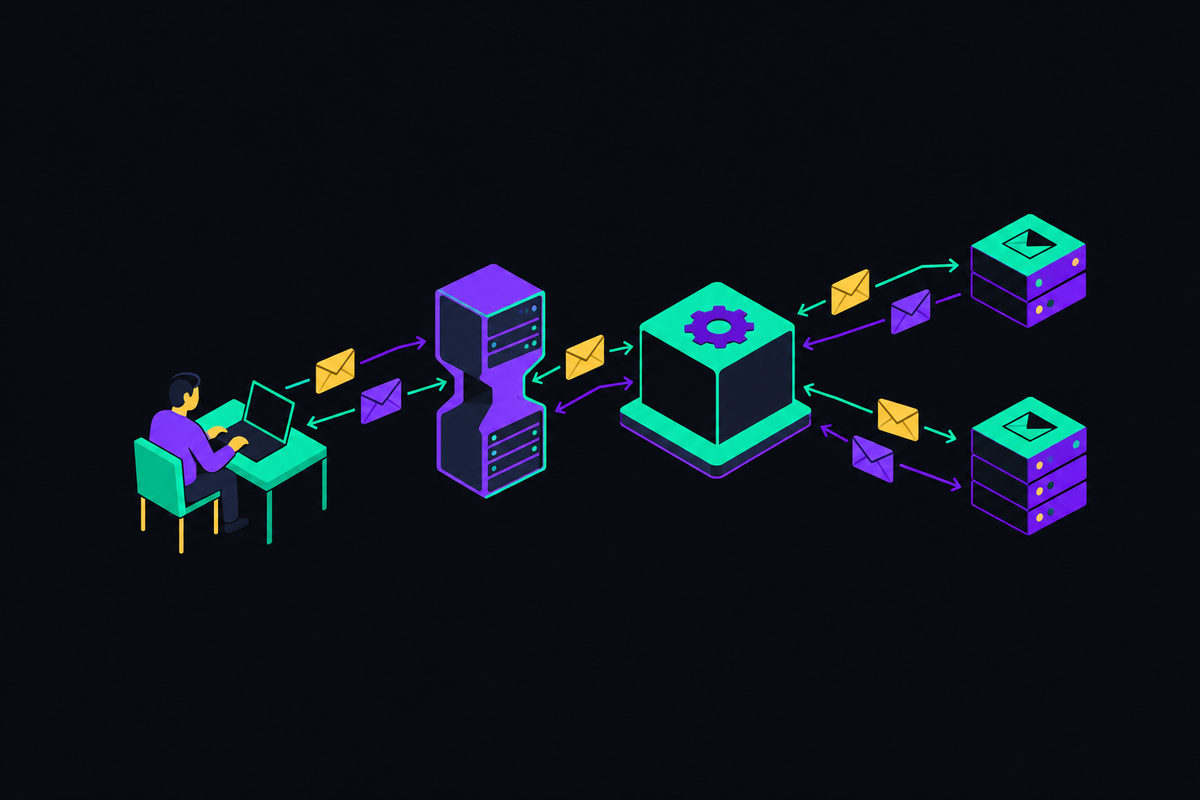
Scheduling email across time zones is not a calendar problem. It is an infrastructure problem. Agents dispatch sends on millisecond logic, and without time-zone-aware guardrails and idempotent scheduling primitives buried in the API layer, they deliver at the wrong moment, at scale, before anyone notices. This piece works through how agent-ready email infrastructure should model scheduled dispatch so that timezone resolution, send-window enforcement, and retry safety live below the agent, not inside its reasoning.
Why scheduling email across time zones is an infrastructure problem, not a logic problem
The failure begins with a structural mismatch. Conventional email APIs were built around a human operator who reviews a send before it leaves the outbox: a person notices the recipient's time zone, weighs the business hour, and adjusts. An agent has no such pause. It fires the send the millisecond the trigger condition is met, and the infrastructure it is wired into assumes that a human already did the checking. That assumption no longer holds.
The mismatch is sharpest at scheduling. A human pauses before hitting send at 3am, reads the recipient's location, and adjusts. An agent works from parameters the model constructed, and those parameters do not include time-zone resolution. Authoritative time-zone data lives in stored contact records, IP inference, and canonical tz databases. The model does not possess that data at inference time. Asking the agent to close the gap on its own logic is asking it to reconstruct facts it never had.
The consequence is silent failure. A password reset arrives at 3am local time. A marketing broadcast lands during a recipient's business blackout window. A retry loop resends a time-sensitive message hours after the window has closed. Each send is correct from the agent's perspective: the trigger fired, the parameters were valid, the API accepted the request. Each is wrong from the recipient's perspective. This gap between human pause-and-review and agent millisecond dispatch is precisely what purpose-built agent email infrastructure addresses. GIC - Agent Send and similar platforms embed pre-send guardrails that intercept timing violations before dispatch, ensuring agents cannot silently misfire on local-time constraints without explicit machine-readable error and fix guidance.
How agents misfire on timing — and why the failures stay invisible until they scale
Agent timing failures are not immediately visible because the send succeeds at the infrastructure layer. The message is delivered, the API returns 200, and no error is logged. The recipient simply receives it at the wrong moment, and nothing in the system records that anything went wrong. Failure here is a property of the recipient's clock, not the sender's logs.
Three failure patterns recur. The first is trigger-time dispatch: the agent fires the send the moment an event occurs, whether that is a signup, a purchase, or an expiring link, without checking the recipient's local time. The second is retry-window blindness. A send that times out is retried without checking whether the original send window still applies, so the retry may land hours later, after quiet hours begin or after the scheduled window has closed. The send window constraint is evaluated once, at first enqueue, and never revisited.
The third is enqueue-time versus send-time preference mismatch. Quiet-hour and send-window preferences are evaluated when the message is enqueued rather than when it is dispatched. A message enqueued at 9am and delayed by a queue backlog can still land at midnight if the check is not repeated at send time. The preference was honored once, at the moment of intent. The dispatch honored nothing.
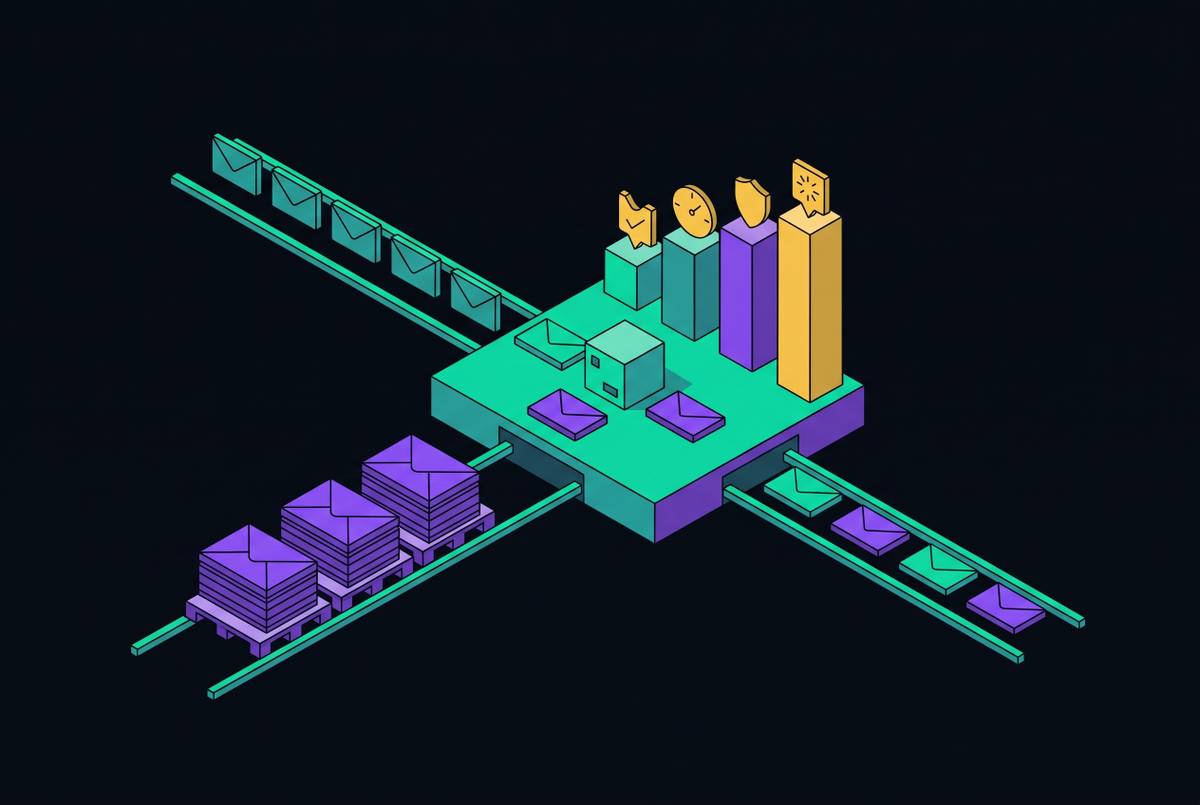
The scale multiplier makes the problem acute. Agents ramp the way software ramps: instantly. If a misconfigured send window affects one message in a human workflow, it affects every message in an agent workflow, simultaneously, before anyone notices. Because the send succeeds at the infrastructure layer, the failure stays hidden until it scales across thousands of agent-dispatched sends. This is why the fix must live at the API layer itself, not in post-send monitoring. Agent-ready email infrastructure must catch timing violations before the send leaves the platform, because after it leaves, the only record of the mistake is a recipient's inbox at 3am.
What time-zone-aware dispatch actually requires at the data layer
Reliable local-time dispatch requires authoritative time-zone data attached to the contact record, not inferred by the agent at send time from whatever context the model happens to have. The data model is the fix. What the data layer must store and maintain is specific: a canonical IANA time-zone identifier, such as America/Chicago, stored on the contact record. Not a UTC offset. Offsets break at daylight saving transitions. Identifiers do not.
Every stored time-zone value needs provenance. The source of the signal matters: IP-derived at signup, user-declared in preferences, or inferred from engagement history. Each source carries a confidence level, because IP inference is wrong for VPN users and mobile roaming. A last-updated timestamp is equally necessary, because contacts move and time-zone data goes stale.
Enterprise platforms have settled this question. They draw on time-zone data stored in contact records, from manually set time-zone properties, with IP-derived time-zone data used as a fallback. They then batch recipients by their time zone so each batch receives email at the same local time, even though actual send times differ dramatically. This is a data architecture decision, not a sending decision. The batching happens because the data is resident and trusted.
For agents specifically, the data layer has a second responsibility. When an agent references dates, times, or expiring links in message content, the correct time zone to use is the recipient's stored time zone, not the server's clock or the agent's system prompt time. A mismatch here creates a distinct failure mode: the send lands at the right time but the link expiry stated in the body is wrong for the recipient. This is why transactional and marketing email platforms built for agents need time-zone resolution baked into the API itself, alongside compliance and delivery semantics. The authoritative mapping must be owned by the email infrastructure, not reconstructed by the agent at send time.
When stored time-zone data is absent, the fallback hierarchy is ordered. First, declared user preference. Second, IP-derived identifier from the most recent authenticated session. Third, engagement-history inference: when does this contact typically open? Last resort: default to a conservative send window in the sender's own time zone and flag the send as unresolved for later enrichment.
The API contract that makes time-zone-aware scheduling safe for agents
A time-zone-aware scheduling API for agents must express send intent in local time and own the UTC conversion itself. Agents that compute UTC offsets and pass absolute timestamps are one daylight saving edge case away from a silent mistimed send. The contract must make that computation impossible by removing it from the agent's responsibility.
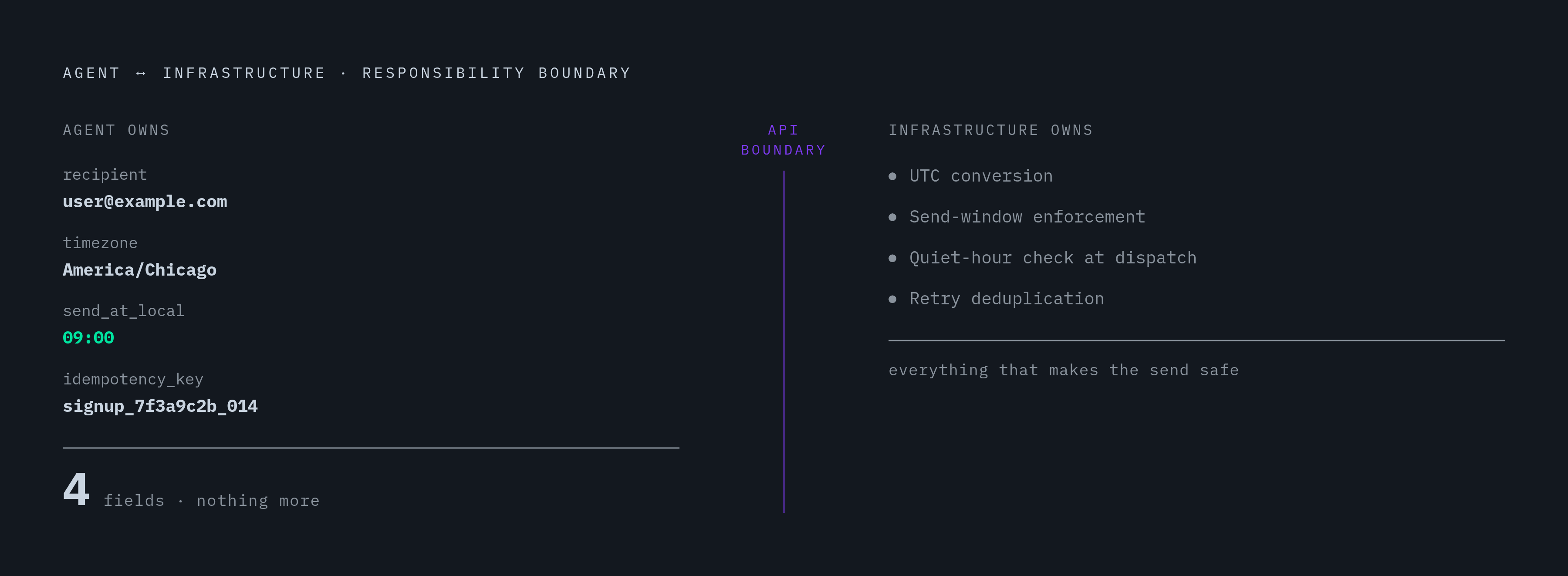
The specification is narrow. The agent passes three things per send. The recipient time-zone identifier is taken from the contact record, the send intent is declared in local time as send_at_local or a send_window, and an idempotency key is included. The idempotency key is recommended but optional on every scheduled send. If a retry arrives with the same key within the deduplication window, the API returns the original response without re-dispatching. The agent cannot accidentally double-send a timed message.
The API owns everything else: conversion, window enforcement, quiet-hour checking, and retry deduplication. The agent's role in this contract is minimal by design, and that minimalism is the safety property. The model declares intent. The infrastructure enforces constraints. Every computation that involves authoritative time is moved below the line where the agent operates.
Idempotency and retry safety for scheduled sends
The correct architecture for exactly-once scheduled dispatch begins before the send exists. Insert the outbox row atomically with the event that triggers the send, the signup, the purchase, the expiry, not after, and not in a separate transaction. The send and its trigger are one unit of work.
Every send attempt carries the same message ID derived from the idempotency key. If the network times out and acceptance is unknown, the reconciliation step searches by that ID before issuing another send. The idempotency window must cover the full send window plus retry backoff. A key that expires in minutes does not protect a message scheduled hours ahead.
When retries exhaust within the allowed window, the message goes to a dead-letter queue. It is flagged for human review, not silently dropped, and not sent outside the window. The window constraint is re-evaluated at every retry, not just at first enqueue. That is the point the architecture exists to enforce.
The protocol layer cannot be relied on here. Agent infrastructure gap analysis identifies idempotency enforcement as a responsibility that current protocol layers leave to the client protocol, via underlying sub-protocols like JSON-RPC. The idempotency guarantee must be explicit in the email API contract, not assumed from the underlying transport.
What the agent's audit log must record for every scheduled send
Without a structured audit log that captures both the agent's declared intent and the infrastructure's dispatch decision, there is no way to diagnose why a message landed when it did, or to prove it landed within the intended window. The audit log is where the silent-failure problem finally closes. What was invisible at the API layer becomes traceable after the fact.
The minimum fields are concrete. Agent ID and agent execution ID identify the specific run that triggered the send. The message ID, derived from the idempotency key, ties every record to its retries. Recipient address and stored time-zone identifier at send time capture what the infrastructure knew. Declared send intent records send_at_local, send_window, and quiet_hours as the agent passed them. Computed UTC dispatch time shows what the API resolved the local intent to. The governance decision records whether the send was dispatched, held to the next window, or blocked, and why. Actual delivery timestamp anchors the record in reality. And if the send was initiated via MCP, the tool call parameters belong in the log.
The log serves two distinct purposes. Operationally, it answers why a message landed at 3am. For compliance, it answers whether the team can demonstrate that quiet-hour enforcement was applied. The same fields serve both audiences. The difference is only in what question is being asked of them.
How MCP tool definitions should expose scheduled dispatch to agents
An MCP tool definition for scheduled email dispatch must encode the time-zone and send-window constraints in its schema, not leave them as optional fields the model may or may not populate. The point is to make it structurally impossible for the agent to issue a valid call that violates dispatch safety. The schema is the guardrail.
The field definitions are specific. The timezone field is required, a string in IANA format. Schema validation rejects an absent value before the call reaches the sending layer. Rejecting a malformed IANA timezone string requires a custom format validator or an enum, because JSON Schema's format keyword is annotation-only by default and does not enforce IANA correctness. The idempotency key is also required. The schema enforces it. The model cannot omit it.
The error contract matters equally. The error response shape is typed JSON with isError set to true, and error detail in the content field, or optionally in structuredContent. The agent can branch on these without parsing a human-readable message. A machine-readable rejection is the difference between a safe halt and a misread.
The governance responsibility shifts upstream when an MCP tool call from an LLM arrives at the server. The server must enforce validation, not assume the caller is trusted application code. The model constructed the parameters, and the model can be wrong. An MCP server that exposes email scheduling without enforcing time-zone and idempotency constraints in its schema is not agent-safe. It is a human API with an MCP wrapper.
Building the scheduling layer on top of AgentSend
The scheduling primitives described here, local-time send intent, send-window enforcement, quiet-hour checking at dispatch time, and idempotency, belong in the infrastructure layer. GIC - Agent Send provides idempotency and send-budget enforcement as a unified API so the agent does not have to implement them. The developer configures the infrastructure once. The agent declares intent per send.
What the developer configures once: sending domain and DKIM authentication, set up at the account level and inherited by every send the agent issues. Default quiet hours and send-window policy, enforced at dispatch time across all sends, not configured per message. What the agent passes per send is narrow: recipient address and stored IANA time-zone identifier from the contact record, local-time send intent, and an idempotency key derived from the event that triggered the send. A short sketch shows the shape of the contract:
{
  "to": "recipient@example.com",
  "timezone": "America/Chicago",
  "send_at_local": "09:00",
  "idempotency_key": "signup_7f3a9c2b_014"
}
The pattern is not complex. That is the entire point. All the machinery that makes the send safe, the UTC conversion, the window enforcement, the quiet-hour check, the retry deduplication, lives below this interface.
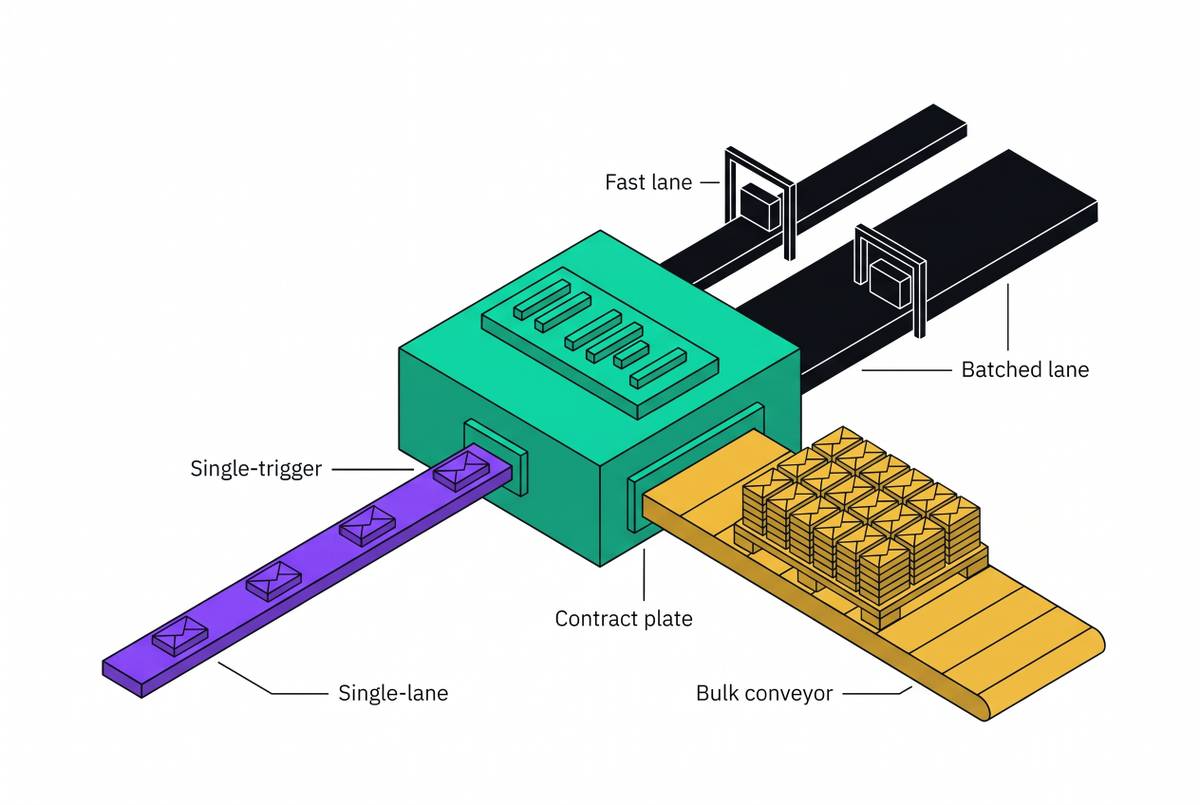
Transactional and marketing sends share one API. The agent does not maintain two separate integrations with different scheduling semantics, which eliminates a class of bugs where a marketing send inherits a transactional send's window policy or vice versa. With one unified API for both send types, the question of which scheduling rules apply never arises at the agent layer. The agent declares what it wants. The infrastructure resolves when it is safe, and proves afterward that it happened.