Why Human-Era Email APIs Become Bottlenecks When an MCP Tool Owns the Full Send-Receive Loop
Email APIs assume a human closes the loop, and agents can't.
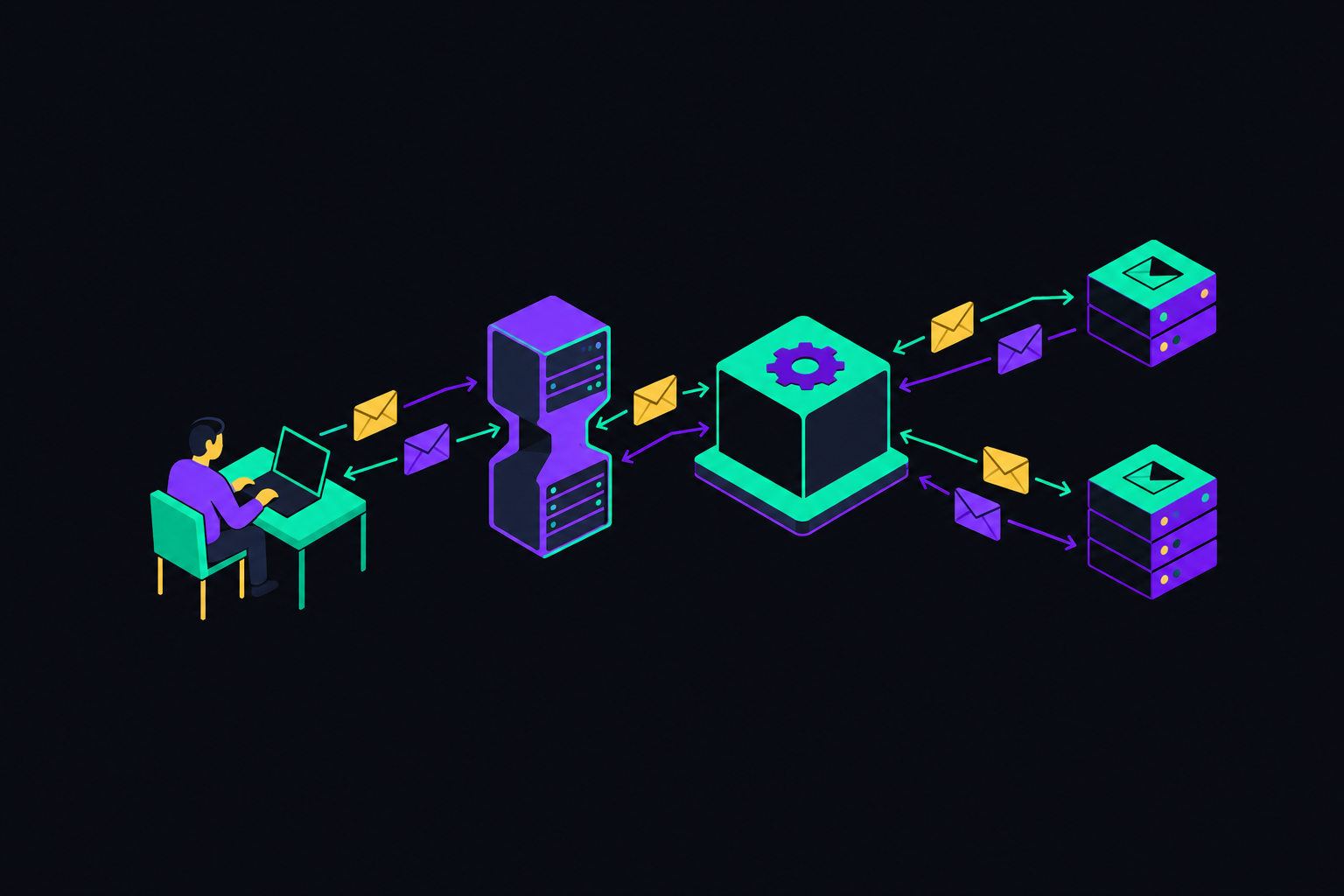
Email infrastructure built for AI agents must have programmable inboxes, structured inbound events, platform-managed threads, and per-agent controls that apply before messages leave the system. When an MCP tool owns the full send-receive loop, those capabilities are requirements for autonomous operation. Human-era email APIs become bottlenecks because they leave essential work to a person or mail client, making the mismatch architectural.
Why the design assumptions of human-era email APIs break under agentic workloads
Conventional email APIs were built around an implicit invariant, namely that a human reviews before sending and reads replies outside the sending API. That assumption shaped the division of responsibility. The platform handled delivery, while a person made the decisions and kept the conversation going through a mail client. The API did not need to own the whole exchange because its intended user already supplied the missing work.
That division works for human-paced workflows. A person can authorize access through a browser, keep using the resulting token across sessions, and consult the inbox before responding. The mail client supplies context that the sending endpoint does not expose. What looks like a complete email capability is therefore a combination of infrastructure, client software, and human attention.
An autonomous agent takes the human out of that process but may leave the human’s work undone. If the agent must decide what happens next, delivery confirmation alone cannot tell it whether a conversation has advanced or whether another message is appropriate. Understanding this original allocation of responsibility is the prerequisite for diagnosing the gaps. They arise from work the API was never designed to perform.
What it means for an MCP tool to own the full send-receive loop
Owning the loop means the agent provisions a sending identity, composes and dispatches a message, receives and parses the reply, maintains conversational continuity, and decides the next action. No human sits in the critical path. The agent observes inbound events, interprets them against thread history, chooses whether to send, wait, escalate, or stop, and executes through tools. Its content, timing, and targets can change at runtime.
MCP exposes operations such as send, receive, reply, search, and thread through tools with JSON schemas. The model produces a structured function call, the MCP server validates it, and the operation executes. An unexposed tool is unavailable through normal tool selection. However, schema validation constrains argument shape rather than proving intent or authorizing an action, and prompt injection and tool poisoning remain risks. Owning the full loop means carrying out each step and keeping it within limits the system enforces.
Gap one: no programmatic inbox provisioning
An agent assigned a task needs a new inbox, but the human-era sending API offers no call that creates one. Its starting point is a domain and sending address that someone has already configured. That is sufficient for an application using an established sender, but not for an architecture that creates an agent instance for each tenant or task.
A support agent may serve multiple tenants. Sharing one sender address collapses thread context and deliverability reputation across those tenants, while separate agent instances need their own addresses. Provisioning becomes part of task execution. Yet the traditional sequence requires someone to add a domain, verify DNS records, configure DKIM, and wait for propagation. The agent cannot complete its task while that prerequisite remains outside its tools.
OAuth consent flows that require a browser session and a person to authorize access cannot be completed by an unattended agent on those terms. The appropriate abstraction is a provisioning call that returns a working inbox, with SPF, DKIM, and DMARC already configured and scoped credentials available immediately. This moves the setup boundary outside the agent’s task, rather than asking the agent to imitate an administrator.
Gap two: inbound handling as an afterthought, not a first-class event
Even a provisioned sender cannot complete a conversation through an outbound-only interface. Transactional APIs were designed primarily as one-way pipes, with delivery confirmation marking the end of their responsibility. A person would read any response in a mail client. For an agent, however, execution can continue only if a scheduling reply, verification code, or customer response allows it.
Polling makes the consumer keep asking whether a message has arrived, which uses resources and leaves a delay between when the message arrives and when the consumer finds it. A webhook-first architecture delivers an event when the message lands. The distinction is not whether the agent can eventually retrieve a reply, but whether receipt directly drives its next action.
Raw MIME can include nested boundary tags, base64-encoded blobs, tracking pixels, quoted chains, and noisy CSS. Feeding that wire format into an LLM consumes tokens and can increase attention drift. The platform should deliver a parsed, structured representation.
Hostinger’s May 2026 launch of Agentic Mail framed webhook-first delivery as a response to this problem, with incoming messages triggering automated actions without polling. The service also lets developers define the domains and addresses an agent may contact. The inbound design illustrates a change in the assumed receiver. A program needs an actionable event.
Gap three: thread state lives in the UI, not the API
Human mail clients show threads in a familiar interface and hide the work of handling the headers that link messages together. Conventional transactional APIs leave that association to the developer rather than maintaining conversation state for the sender. The agent has to manage state where a human just sees a reply button.
RFC 5322 defines the In-Reply-To and References headers used in that association. To answer a scheduling reply within the existing conversation, the agent or its supporting code must retrieve the relevant Message-ID, set In-Reply-To correctly, and extend the References chain. These are protocol details. If the platform does not manage them, the developer must supply the storage and association logic behind each reply.
Across many tenants, that logic must reliably recover the right conversation context. Otherwise, replies can appear as new threads, fragmenting the exchange for recipients and signaling anomalous behavior to spam filters. The dangerous part is the absence of an obvious failure. A broken References chain does not necessarily produce a send error, so the agent can continue operating without recognizing that the recipient sees a disconnected conversation.
Agent-native infrastructure absorbs that complexity explicitly. The platform stores thread state, associates inbound replies with originating outbound messages, and supplies the full thread with the new-message event. Humans could rely on a client interface to hide the protocol. An autonomous agent needs the platform to preserve the same continuity as data it can use.
Gap four: safety controls exist at the account level, not the agent level
A correctly provisioned, inbound-capable, thread-aware agent can still send the wrong message successfully. Human-era controls such as daily send caps, suppression lists, and unsubscribe enforcement operate largely at the account level. They assume that composing and reviewing messages imposes a natural brake on sending. An agent can create and queue many messages in seconds, so that brake is gone and there may be nothing else to slow it down.
A misconfigured agent can damage a domain’s sending reputation before the account cap triggers, while account-level logs may show the messages without identifying the agent execution responsible. Recovery then requires more than fixing a single failed call. The infrastructure needs both limits tied to the acting agent and attribution that makes its activity distinguishable from other senders.
Silent failures are particularly consequential at this speed. Unrendered template variables and missing unsubscribe links do not have to cause a send error to damage reputation. They can reach thousands of inboxes before complaints produce a monitoring alert. An agent instructed to answer every incoming message can also respond to auto-replies, creating a cascade that a human would recognize and stop.
Inbound content introduces an additional safety boundary. A malicious email can try to redirect an agent toward forwarding an invoice or exfiltrating data, so every incoming message must be treated as untrusted input. Correctly parsing the message does not make its instructions authoritative. Neither a valid tool call nor successful delivery establishes that the action was appropriate.
A guardrails approach belongs at the boundary between the model’s decision and dispatch. The required pre-send linting layer checks unrendered variables, missing compliance headers, suppression status, and per-agent rate limits, then blocks a failing send and returns a machine-readable error with a specific fix. Post-send monitoring can show damage after delivery, but autonomous sending needs controls the system can enforce before the message leaves.
Why retrofitting a human-era API doesn't close these gaps
An MCP wrapper changes how an agent invokes an operation. It does not automatically change what the underlying platform can do. If the original API assumes an already configured sender, a schema around that endpoint cannot create an inbox. Manual DNS setup and human OAuth consent remain prerequisites even when the agent can call every exposed tool correctly.
The same inheritance applies after sending. A wrapper around an inbox accessed through IMAP polling still needs to poll, and raw MIME still needs parsing somewhere. Passing Message-ID and In-Reply-To through tool arguments does not create a durable thread store or associate replies automatically. Those responsibilities remain with the agent’s supporting application unless another component actually implements them.
Safety controls likewise retain their original scope. An account-wide limit still applies to the whole account after the endpoint becomes an MCP tool, and making a send operation available as a tool leaves validation before dispatch to be added. A wrapper can have added services and logic to enforce limits, but those additions do new infrastructure work. Their existence should not be confused with a benefit supplied by the tool schema itself.
Wrapped APIs work well when they expose operations that already fit the task. The limitation appears when a new interface is expected to replace capabilities absent from the system underneath it. A platform’s tool surface reflects the sender model it was built to serve, even when that surface is presented through MCP.
What agent-native email infrastructure addresses at the design level
Email infrastructure built for AI agents starts with what the platform must do when an agent works on its own. Provisioning returns a usable inbox and scoped credentials through one API call, with authentication already configured. The agent does not pause its task for consent or DNS propagation.
Inbound delivery and thread management then form one conversational handoff. Parsed webhook events provide usable message content at arrival, while platform-managed Message-ID associations connect each reply to its originating outbound message. The full thread arrives with the event. The agent can reason about the next action without parsing raw MIME or maintaining a separate conversation state store.
The fourth requirement is met by checking messages before dispatch, so safety does not depend on watching what happens after sending. The design checks template rendering, unsubscribe headers, suppression status, and per-agent rate limits, returning actionable errors when a send is blocked. Compliance defaults belong in that same execution path. Unsubscribe headers, suppression enforcement, and List-Unsubscribe attachment are on by default.
A unified sending interface also avoids splitting the agent’s work between separate transactional and marketing systems. A single API, MCP server, and CLI provide one route for those sends without separate permission models for each category. This keeps the operational surface aligned with the agent’s task. It does not replace the provisioning, inbound, thread, or safety responsibilities underneath that surface.
Retries provide a final test of whether the platform owns execution details. Each send call accepts a client-generated idempotency key so an unreliable network does not turn a retry into a duplicate message. On receipt, inbound message IDs are stored durably and checked before the agent loop starts, preventing duplicate processing. Autonomous operation requires both sides of that protection, because repeating a valid action can be as disruptive as performing an invalid one.