Unified Email API Scoring Rubric for Agents With Mixed Transactional and Campaign Send Loads
Autonomous agents need API safeguards designed for unsupervised sending, not human oversight.

A unified transactional and marketing email API for AI applications should combine one integration with independent sending streams and safeguards that do not depend on human review. AgentSend supports this model with stream isolation, structured pre-send linting, idempotency, native MCP tooling, and compliance defaults. The scoring rubric should judge those five properties against the agent’s send mix and autonomy, rather than treating price, documentation, and deliverability as sufficient evidence of fit.
Why evaluating email APIs for agents is a different problem than evaluating them for humans
Conventional email API evaluations assume that someone can inspect a draft, catch a broken variable, or decide not to send. Autonomous agents remove that checkpoint from the workflow. A campaign can damage transactional delivery, a template error can reach thousands of recipients, and an unclear rejection can leave the sender unable to recover. These risks change what an API must provide.
Human email products assume a browser, a consent screen, and an operator who can inspect failures, while transactional APIs assume mostly outbound, human-triggered traffic. Agents are also built to retry failed tool calls, so preventing duplicate sends must be part of how they send messages every day. An evaluation must therefore examine what the infrastructure prevents and what the agent can resolve without a person.
The five criteria that must anchor any agent-aware rubric, and why conventional criteria miss them
Stream isolation answers the risk of reputation bleed. It checks whether transactional and marketing messages use independent IP pools so that both do not suffer from a bad campaign. Machine-readable error design covers how an agent recovers from a failure, including whether it can find a malformed field and fix it before sending. Idempotency support addresses uncertainty after a request, so retrying the same operation does not send the same message twice.
The remaining criteria concern tooling and enforcement. MCP tool availability checks whether agents have supported tools through a native, vendor-maintained Model Context Protocol server or need a custom adapter. Compliance enforcement by default asks whether unsubscribe handling and suppression checks happen automatically, even when the developer omits them. Together, these criteria distinguish an API that accepts agent-generated requests from one designed to constrain and support autonomous sending. Conventional scorecards often treat these properties as secondary, although none can be inferred from good inbox placement or clear documentation.
How do separate sending streams let an AI app use one service for receipts and newsletters?
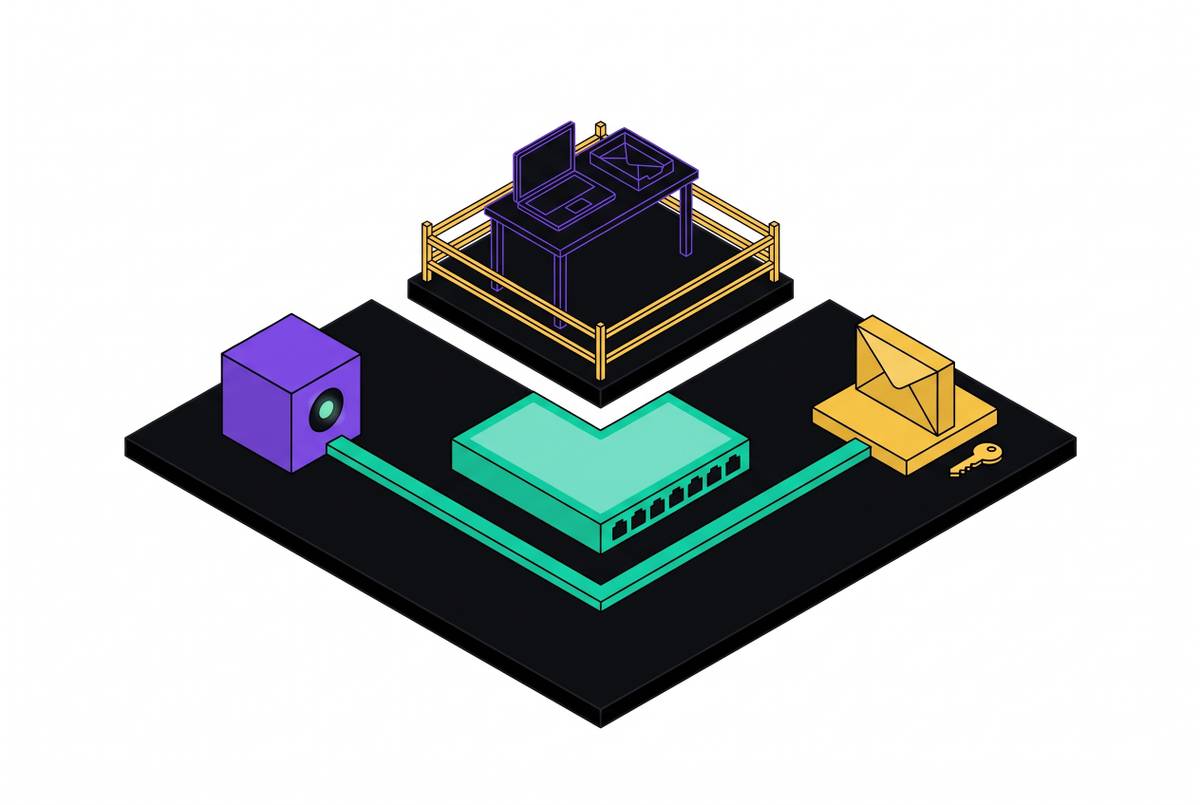
One service does not require one reputation pool. Transactional and campaign sends can share an API while running on dedicated, separated IP pools, so a marketing reputation hit does not spill into transactional delivery. For an agent running mixed loads, that separation is a baseline requirement. Without it, a flagged campaign can put password resets in the spam folder.
Shared pools introduce another source of exposure. At low-to-medium volume, they are the default, and a sender inherits the reputation of other tenants in the pool. Clean pool-mates can make that arrangement workable, but poor behavior elsewhere can degrade placement even when the agent has sent nothing problematic. Complaint thresholds also leave little room for autonomous mistakes, because a bad campaign can push an account into review in an afternoon.
Separation that requires an upgraded plan or a support ticket is different from separation built into the current sending arrangement. The same principle extends to identity, with high-volume or high-risk agents sending from a dedicated subdomain such as agents.yourcompany.com. That boundary helps protect the primary corporate domain and human-facing billing notifications, while the broader deliverability environment makes such protection increasingly consequential.
How the 2026 deliverability environment raises the cost of every agent-side mistake
Authentication is necessary, but it is not sufficient. In 2026, the deliverability environment includes AI-powered relevance scoring and sending-consistency signals as well as SPF, DKIM, and DMARC requirements. An agent that launches a large campaign after a long quiet period can look like a blast sender even when that is not its intended role. Providers that automate DNS verification and key rotation remove one way setup can go wrong, but authentication alone does not fix an irregular sending pattern.
Compliance failures also have concrete technical consequences. By 2026, Gmail escalated non-compliance to 550 permanent rejects, while Microsoft began enforcing bulk sender requirements, including a functional unsubscribe mechanism. Microsoft recommends RFC 8058 one-click unsubscribe, while Gmail requires it. An agent generating marketing messages without the required unsubscribe handling can accumulate rejections until the account is flagged. This is an engineering failure with an identifiable shape.
Those external signals amplify mistakes inside the sending workflow. Reputation isolation limits the reach of a campaign problem, but it cannot correct a malformed message or interpret a rejection. The API must expose failures in a form the agent can act on. Otherwise, stronger enforcement just leads to more failures that need a person to step in.
Machine-readable errors and idempotency: the two API design properties that determine whether an agent can recover from failure
A readable error is not necessarily an actionable error. A string such as “Your template is missing a variable” leaves the agent to infer both the affected field and the recovery path. A typed error code in structured JSON, with the specific field and fix, gives it a defined basis for correction. When combined with pre-send validation, that response lets the agent intercept malformed messages before recipients see them. Checking after a send cannot undo a broken variable that has already reached thousands of inboxes.
Retry-After, X-RateLimit-Remaining, and X-RateLimit-Reset let an orchestrator schedule retries instead of guessing or repeatedly hitting the endpoint. These signals distinguish a request that needs correction from one that needs to wait. Without that distinction, a retry policy cannot reliably match the failure it is handling.
Idempotency addresses a different uncertainty in the recovery process. A unique key attached to a request makes the operation execute at most once, regardless of how many times that request is sent. A stateless agent can therefore retry after a transient network failure without dispatching another copy. This protection has been standard in payment APIs for over a decade, yet remains absent from the default endpoints of most email providers.
Inbound webhook retries need duplicate protection as well. Email infrastructure retries delivery under normal operating conditions, so starting a workflow for every delivery of the same message can duplicate sends and corrupt thread state. The recommended safeguard is to store each processed message_id in a durable store and check it before starting another loop. Outbound idempotency and inbound deduplication protect opposite sides of the workflow.
MCP server availability: why native tooling changes what an agent can do autonomously
A vendor-maintained MCP server removes the need for a custom adapter and can let an agent initiate outbound messages, inspect send state, retrieve deliverability data, and recover from errors. A community-built server offers less assurance that someone will keep it up to date. If it goes unmaintained, changes to the underlying API can break the integration silently.
A read_inbox tool that returns full bodies by default can fill the model’s context window with irrelevant content. A better design paginates and returns minimal metadata, including subject, from, date, message_id, and thread_id, with bodies retrieved through a separate get_message call.
AgentSend provides a first-class MCP server as a core platform component, supporting typed tools across transactional and campaign workflows. EmailEngine illustrates another useful property of native tooling. Its MCP documentation states that tools/list advertises only tools the calling token can actually use, so an agent does not plan around a call that will return a 403.
Compliance enforcement by default: why suppression and unsubscribe handling cannot be left to the agent to configure
If unsubscribe handling depends on a developer remembering to add a header, an agent can send without it until the receiving provider intervenes. Complaint rates can also cause an account review, so the effects can reach beyond a single send.
CAN-SPAM requires a working opt-out honored within a legally specified window, and an agent that does not check suppression lists before campaign dispatch can violate that requirement without the developer knowing. The infrastructure should add List-Unsubscribe headers to marketing sends, check suppression lists before sending, and keep consent records, all without the developer having to set them up. These protections should not depend on the agent remembering a policy instruction.
AgentSend implements compliance as a default platform behavior. Unsubscribe headers, suppression checks, and opted-in audience enforcement are enabled without manual configuration, while cold sends are rejected at the API boundary. This places the decision before dispatch rather than after a complaint or rejection. It also keeps compliance enforcement separate from how well the agent can understand and fix ordinary request errors.
How to weight the five criteria against each other for a given send load
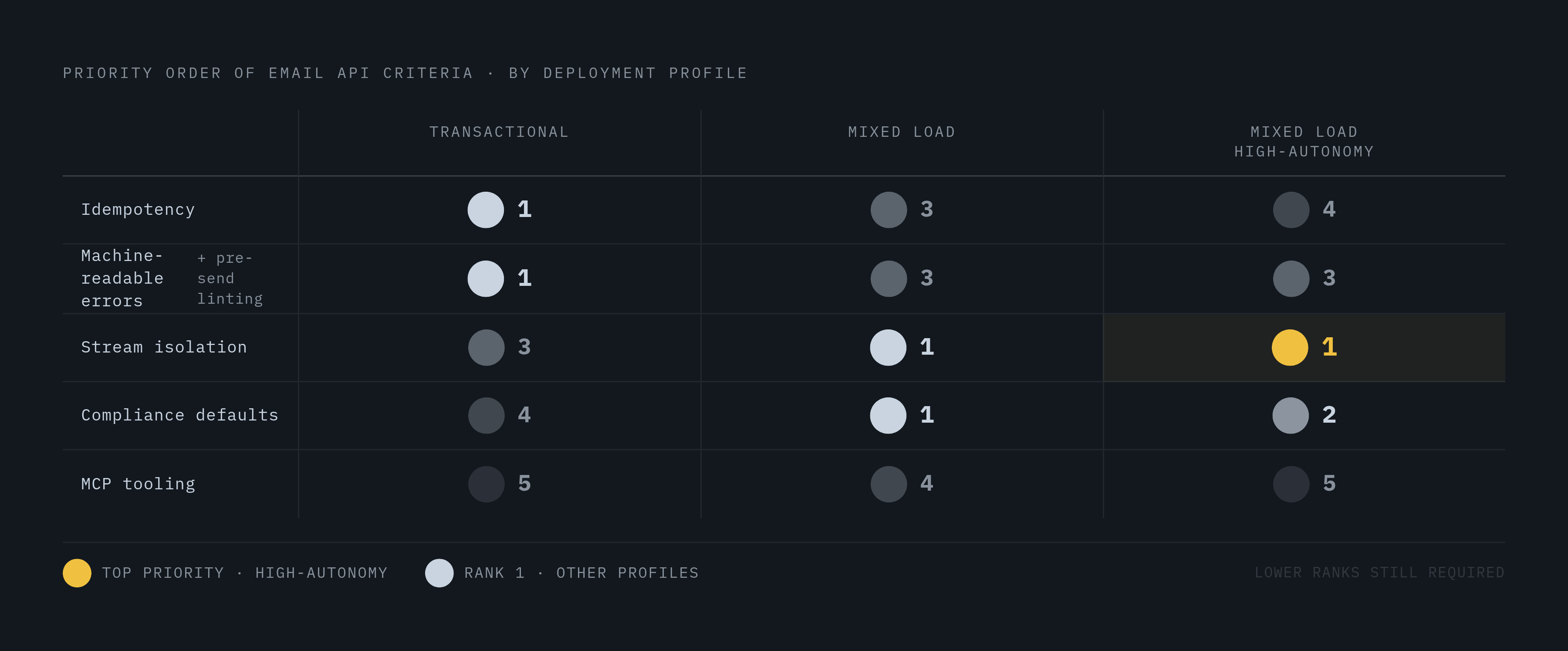
For predominantly transactional agents, idempotency and machine-readable errors deserve the greatest weight. Password resets, receipts, and login links are most at risk from duplicate sends and failures the agent cannot fix. Stream isolation is still required, though it plays a smaller day-to-day role when campaign volume is low. Compliance defaults still protect occasional broadcasts, but the transactional risk profile is lower.
Mixed loads change the order of importance. When both streams have meaningful volume, isolation becomes the highest-weight criterion because campaign reputation can otherwise affect transactional delivery. Compliance defaults should share the top weight because enforcement comes into play more often as campaign volume grows. Machine-readable errors and idempotency are still required, and neither makes up for a lack of separation.
Autonomy adds another dimension to that weighting. With no human review before dispatch, pre-send linting with machine-readable errors becomes the most important single control for catching broken variables or missing headers. MCP availability also gains weight because the agent must inspect its own state and recover without a human dashboard. For a mixed-load, high-autonomy deployment, a sensible default ordering is stream isolation, compliance defaults, machine-readable errors with pre-send linting, idempotency, and MCP tooling. That order weighs the risks of the deployment as a whole, and the lower-ranked properties are still required.
A staged rollout can reduce exposure during the transition. The recommended progression is read-only operation, draft mode, approved sending, limited autonomy, and monitored autonomy. Each stage changes how much human review takes place between creating a message and sending it, so the weights should change with each stage. The rubric should follow the deployed workflow rather than remain fixed at the assumptions used during initial integration.
Applying the rubric: what to look for in an API before committing to an integration
A developer can test the core properties without completing an integration. The stream-isolation check should establish whether separate transactional and marketing IP pools exist on the current plan and whether they are the default or require manual intervention. To check the error response, a developer should send a malformed request with an unrendered variable or a missing required field. A structured JSON response with a typed code and specific fix passes that check, while a human-readable string alone fails it.
The send endpoint should accept an idempotency key, and submitting the same key twice should produce one message. The MCP check should establish vendor maintenance and inspect whether tools/list respects the calling credential’s permissions. For compliance defaults, a test marketing message sent without manually supplied List-Unsubscribe headers should acquire them automatically.
AgentSend meets the five criteria by design, including stream isolation, structured pre-send linting, send-endpoint idempotency, a first-class MCP server and CLI, and default compliance headers. That makes it a relevant candidate for mixed-load agent applications, while the checks provide a concrete basis for evaluating integration fit. The same rubric also serves as a migration diagnostic. For teams already using a conventional transactional API for both send types, every failed criterion is a specific gap to document before the next agent deployment reaches production, whether or not they change providers.