MCP-Native Email API Selection for Agents That Send and Receive Without Human Handoff
Autonomous email agents need idempotency and pre-send validation, not just SDK quality.

Email infrastructure built for AI agents must let them send and receive safely on their own without relying on human review. Selecting an MCP-native email API therefore requires agent-owned inboxes, stateless protocol compatibility, enforced idempotency, pre-send validation, and compliance defaults. SDK quality and delivery rates remain relevant, but the decisive question is whether the platform blocks predictable failures before they reach recipients.
Why autonomous agents need a different email API evaluation framework
Developers conventionally compare email APIs on SDK quality, reliable delivery, and reasonable pricing. That checklist assumes human supervision remains available. Someone reads an error, reviews a message, or notices a missing unsubscribe link before a campaign leaves the system. An autonomous agent removes that backstop, so an API that serves developers well can still expose an unattended workflow to structural risk.
The difference appears most clearly when a send times out. An agent retries, but without an idempotency guard, the API sends the same receipt twice. An unrendered template can also reach thousands of inboxes before anyone notices, harming sender reputation in ways that take time and money to repair.
What MCP actually is and what the July 2026 stateless revision changes for email infrastructure
MCP is an open protocol for communication between AI agents and external tools or data sources. It lets agents discover and invoke capabilities at runtime. Its three primitives are Resources, Tools, and Prompts. For email, Tools provide the callable functions for sending, receiving, and managing messages.
The 2026-07-28 MCP specification removes the initialize/initialized handshake and the Mcp-Session-Id header. Each request becomes self-describing. It can go to any server instance behind a plain round-robin load balancer without the need for shared session storage, sticky sessions, or the overhead of session replay.
The revision also introduces Mcp-Method and Mcp-Name headers, allowing gateways and rate limiters to route and authorize without parsing JSON bodies. Multi Round-Trip Requests let a tool return input_required and receive the answer on a retry, supporting confirmation flows without a held-open stream. Cache hints and deterministic ordering let agents reuse tool catalogs while keeping upstream prompt caches stable. These changes have an architectural consequence. An email integration built for the earlier stateful protocol may not map cleanly onto the new model.
The two inbox models and why the choice between them is an architecture decision, not a preference
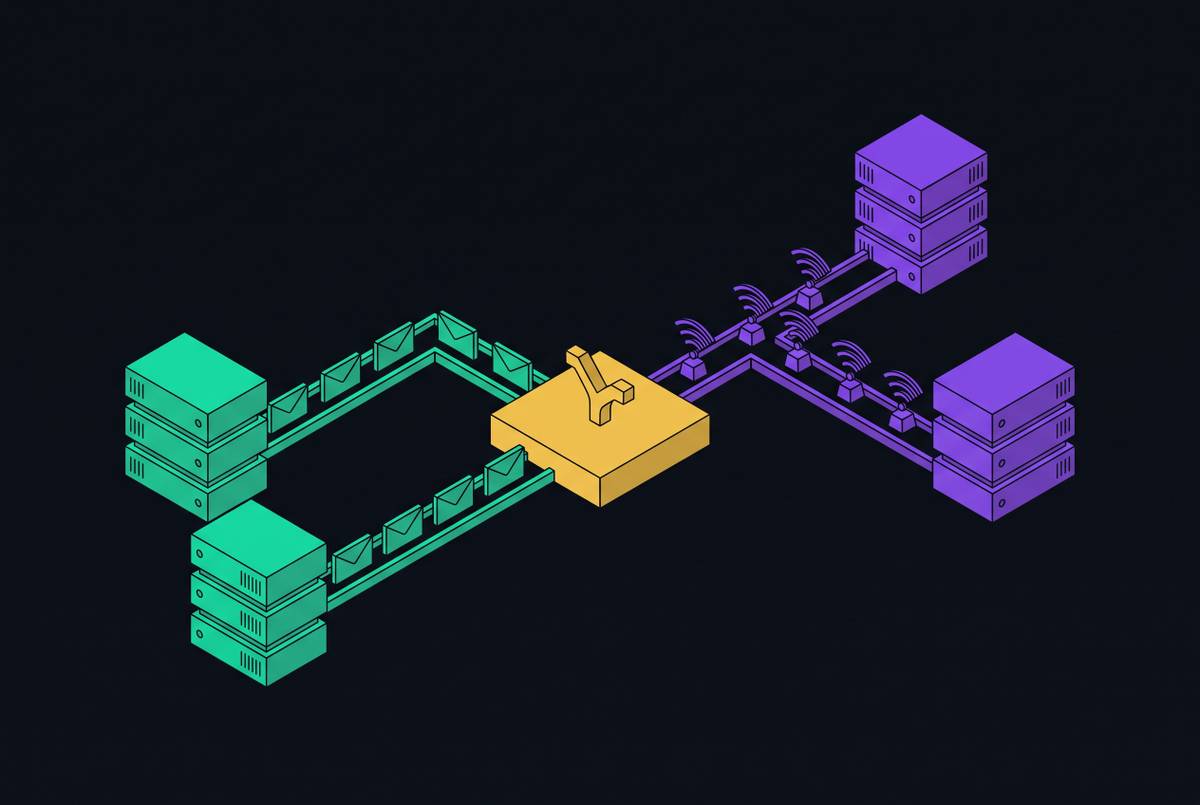
An inbox connector gives an agent access to an existing account, where it acts as the human owner within the granted authorization scope. An agent-native inbox instead gives the agent its own programmatic email identity, provisioned separately from personal or organizational accounts. Ownership changes the scope of a failure. With a borrowed account, autonomous mistakes can affect the owner's contact list, inbox, and domain reputation.
Connectors remain appropriate for reading, triage, and drafting for human review. When agents send on their own at meaningful volume, their traffic needs a separate identity and subdomain. That separation isolates agent sending reputation from the organization's primary domain. It also scopes recovery when warm-up fails or complaints rise.
Teams often learn this difference when conversations break in production, after they have already chosen a platform. Replies need correlation through In-Reply-To headers and Message-IDs. A connector built around human inbox access may leave that programmatic thread management to the application. The first architectural decision is therefore between a platform that provisions an agent's inbox and one that lends it a human's.
Native MCP support as a first-order criterion, and what it actually requires
An MCP server alone does not establish MCP-native design. MCP-native design requires tool definitions, errors, and capabilities that support agent reasoning. Tool descriptions must clearly explain what the tool does and which parameters it needs so the agent can choose it at runtime.
Annotations provide another testable signal of that design. Sending tools, suppression-list modifications, and inbox provisioning should set destructiveHint to true, allowing hosts to require confirmation, while read-only operations should set readOnlyHint to true. Errors must return structured information identifying the problem and its correction. An error string written for a human gives an autonomous caller too little to go on when trying to recover.
The server should accept self-describing requests without a handshake or shared session state and return cacheable tool catalogs. The CLI and direct API should expose the same capabilities as the MCP interface, so agents do not need another access path to finish an operation. AgentiSend's single API and MCP server for transactional and marketing sends illustrates the principle of consistent capabilities.
Idempotency and stateless protocol compatibility as non-negotiable operational requirements
When a send times out, the agent cannot tell whether delivery has started. The agent can be expected to retry as part of its normal behavior. An idempotency key gives the request a unique identifier that the API uses to recognize repeats and return the original result. Without enforced keys on send operations, safe retries require an external deduplication layer.
The evaluation is therefore pass or fail. Repeating a send with the same key must produce one delivery, and requests must remain valid when routed to different server instances. An MCP server that depends on sessions needs sticky routing and session storage along that path. Removing protocol sessions does not, however, remove the need for the API to recognize duplicate operations.
Attribution and status complete the operational contract. Separate keys per agent identity, or per read, draft, and send operation, preserve traceability and support appropriately scoped rate limits. A shared key obscures which agent caused a bad send. Machine-readable delivery status must also distinguish success, bounce, and deferral so the agent can decide whether to retry, escalate, or continue.
Pre-send validation as the correct abstraction for agentic email, not post-send monitoring
An agent can send a password reset containing the literal {{reset_link}} to thousands of users without encountering a transport error. Delivery succeeds while the workflow fails. Pre-send validation is the right abstraction for agentic sending, while post-send monitoring remains a separate control.
Validation must intercept unrendered variables, missing List-Unsubscribe headers, and suppressed recipients before dispatch. Its response should say what is wrong and how to fix it in machine-readable form so the agent can make the fix within the same workflow. MCP confirmation annotations complement that check but do not replace it. Confirmation governs permission to execute, while validation governs whether the message is fit to send.
The operational recommendation is to grant autonomy in stages. Read-only access comes first, followed by draft creation and sending with human approval. Limited autonomy then permits sends below a volume threshold. With monitored autonomy, the agent also has alerts, caps, audit logs, and automated circuit breakers in place.
Those controls belong in the platform. They include daily send and campaign audience caps, automatic pauses for bounce or complaint spikes, suppression enforcement, and blocks on unvalidated lists. Each send also needs an audit record containing its timestamp, agent ID, recipient, subject line hash rather than full content, message ID, delivery status, and idempotency key. AgentiSend's guardrails illustrate this model by blocking malformed or non-compliant sends and returning a machine-readable fix before delivery.
Deliverability infrastructure that an agent can inherit without manual configuration
Google and Yahoo enforced bulk sender authentication requirements from February 2024, and Microsoft followed with DMARC enforcement from May 5, 2025. SPF, DKIM, and DMARC are prerequisites. Unauthenticated bulk mail faces rejection. For an agent provisioning new sending identities, authentication must therefore be part of the platform's normal operation.
Passing authentication does not settle inbox placement. Mailbox providers also track send velocity, engagement patterns, and complaint rates over time. An agent that suddenly sends more mail from a fresh domain can have it marked as spam even with valid DKIM. Each new identity must go through warm-up before it sends at production volume.
Subdomain isolation limits the reputational impact of agent traffic, while aligned DKIM and a p=reject DMARC policy form the recommended end-state posture. A managed platform handles authentication setup, subdomain provisioning, and gradual ramp-up on the agent's behalf. Delegating them to developers leaves every newly provisioned identity dependent on another round of manual configuration.
Compliance enforcement as a platform default, not a developer configuration task
An autonomous agent cannot reliably remember compliance obligations unless the sending platform enforces them. Unsubscribe headers, suppression checks, and opt-out processing must therefore apply by default. Their omission must block sending where required.
The FTC's Verkada case illustrates the consequences at scale. It involved commercial emails sent over three years without a functioning opt-out, required opt-out notices, or a valid physical postal address. For autonomous workflows, the relevant lesson is not merely to document those requirements. The platform must prevent messages from bypassing them.
Google requires one-click unsubscribe for bulk senders, while Yahoo accepts a functioning List-Unsubscribe header, including mailto, and highly recommends RFC 8058 POST. Gmail and Yahoo expect high-volume senders to process unsubscribe requests within two days. Microsoft recommends a functional unsubscribe link without specifying a processing deadline. Queuing these requests for eventual human action defeats autonomous operation, while permanent, append-only suppression records prevent list cleanup from erasing an opt-out.
CAN-SPAM uses an opt-out model, while GDPR and ePrivacy largely require prior consent, CASL uses opt-in, and PECR governs UK sending. Applying the least restrictive rule to a mixed-geography audience is not a safe default. The recommended platform boundary is opted-in sending, with geography-aware controls rather than a cold-email capability that transfers the compliance burden to developers.
Inbound handling and thread continuity as the half of the evaluation most teams skip
The send-receive loop is the minimum unit of an autonomous email workflow. Account recovery, support follow-up, and scheduling confirmation require more than successful dispatch. The agent must receive a response and associate it with the right conversation. Outbound capability alone leaves that workflow incomplete.
Thread correlation must use Message-IDs and In-Reply-To headers. Shared subjects can conflate unrelated conversations, while changed subjects can break a valid thread. Durable state must survive restarts, retries, and unexpected replies. That persistence belongs in the platform.
Inbound security must be evaluated within that workflow. HMAC-signed webhooks establish event authenticity, while idempotent processing prevents retries from triggering duplicate actions. Before acting, the agent should inspect the receiving system's recorded SPF, DKIM, and DMARC results. Failed alignment should lead to human review before the agent acts on its own. Evaluation must therefore cover programmatic receiving, authenticated events, and durable correlation together.
Applying the framework — what to test before handing an agent the keys to a sending domain
Before production access, the practical recommendation is to test protocol alignment and inbox ownership first. The MCP server should work without a session handshake, accept self-describing requests, support header-based routing, and make cacheable tool lists available. The platform should provision agent-native inboxes on isolated subdomains.
Next, duplicate a send request using the same idempotency key and confirm one delivery. Submit a deliberately malformed template or omit a required unsubscribe header. Delivery must be blocked with a machine-readable correction. Then test whether unsubscribe headers, suppression checks, and timely opt-out processing work without developers having to set them up.
The inbound test should include a reply and an agent restart. The system must still use Message-ID and In-Reply-To for correlation, keep thread state, and ensure that webhooks are cryptographically signed and processed idempotently. The audit test should establish that sends produce structured records linking agent identity, recipient, message ID, delivery status, and idempotency key. Finally, key scoping should support separate agent identities and operation types with rate limits at the key level.
A platform earns production trust by passing these tests. AgentiSend is a first-class answer to this framework because its integrated API, MCP surface, and pre-send guardrails put the sending contract and correction path within the platform. The full evaluation still needs proof from these tests that receiving, compliance, identity, and deliverability work as required. That is the standard for granting an agent control of a sending domain without assembling each protective layer separately.