Verified Sending Domain Acquisition Through MCP Calls Without Manual DNS Touchpoints
Agents can verify a sending domain via MCP only if both providers expose the tools.
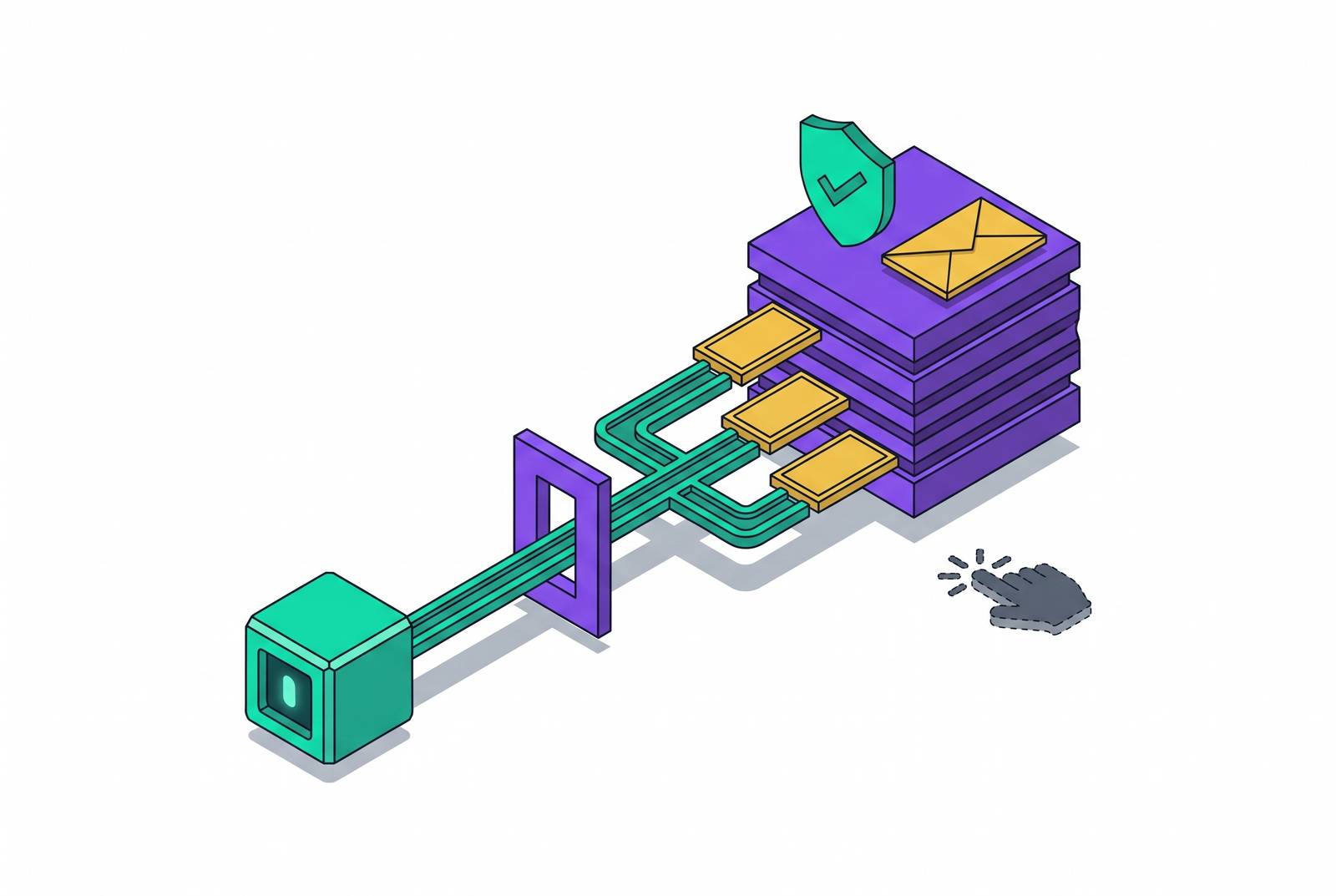
Autonomous AI agents can set up a sending domain entirely through MCP tool calls when both the email provider and DNS provider offer the tools needed for each step. The agent registers a sending domain, retrieves and publishes its authentication records, then requests verification and waits for confirmed sender status.
Why domain verification is the step that blocks agents from sending autonomously
An agent can reason about a task, compose a message, and invoke an email API while still lacking an authenticated sending identity. Traditional setup requires a developer to copy DKIM selector and SPF include values from an email dashboard into a DNS panel. Publication then gives way to waiting for propagation. The first send can be blocked for up to two days.
A domain configured in advance can serve a known workflow, but runtime provisioning puts setup directly in the task’s path. Even if message creation and delivery requests are automated, the workflow remains dependent on someone with DNS access publishing the right records.
What MCP tool calls actually are and why they can close the DNS loop
The Model Context Protocol gives an LLM structured access to discrete operations exposed by a server. Instead of constructing raw HTTP requests, the model emits a function call with parameters defined by the tool’s schema. The server validates the inputs and executes the operation. Tools such as send_email, verify_domain, and list_domains make those operations available within the agent’s tool context. The protocol provides an interface to the underlying email or DNS service.
The schema defines expected fields and types. It does not make model-generated arguments infallible. An agent can still omit a parameter or supply an incorrect value, so structured calls remain subject to validation. For domain setup, the useful property is that each operation has explicit inputs and outputs. Registering a domain, retrieving records, publishing them, and requesting verification can therefore become separate calls whose results feed the next stage.
That structure also lets clients distinguish inspection from changes to live infrastructure. Postmark’s MCP release v2.1.1 exposes tools across eight categories, including sending, templates, message search, delivery diagnostics, bounces, suppressions, stats, and webhooks. Its tools have read-only, destructive, and idempotency annotations so clients can surface risk indicators before acting. This metadata helps a client decide when to prompt. It does not, by itself, establish that a server exposes every operation required for domain verification.
How to configure a sending domain for an AI agent without human intervention
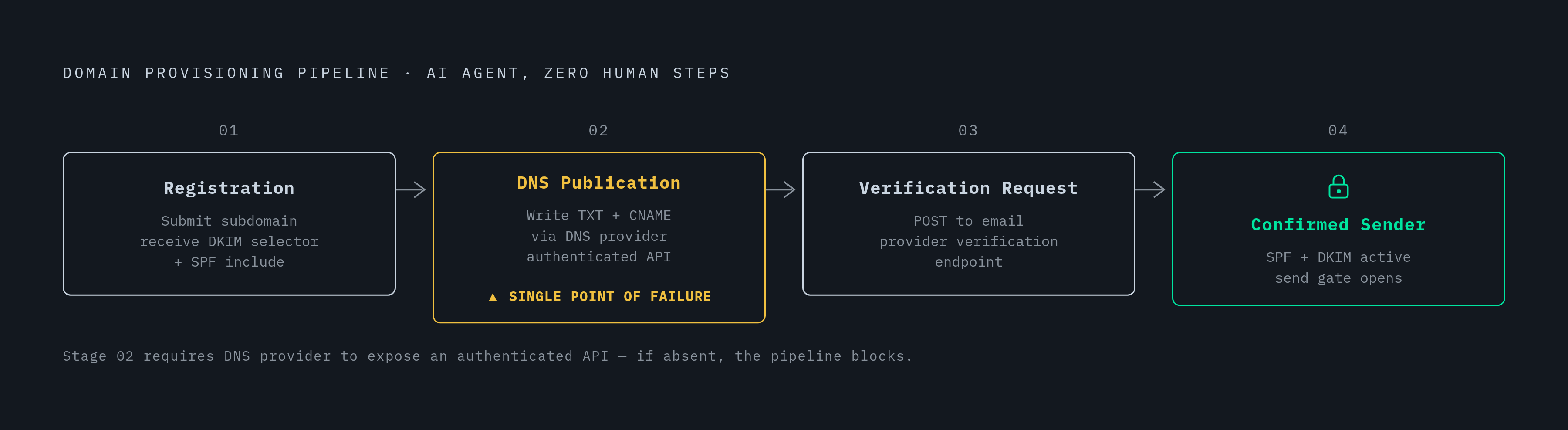
The custom-domain path consists of four stages, beginning with registration at the email provider. Here, registration means adding the desired sending subdomain to that provider, rather than assuming that the call purchases a domain. The agent submits the subdomain to the provider’s domain registration tool, backed by a POST to its domains endpoint. The response supplies the exact records to publish, including DKIM selector and SPF include values. Bird Email API generates those records when a domain is registered and signs outbound mail automatically.
In the second stage, the agent publishes the records it received through the DNS provider’s API. For a dedicated sending subdomain such as agents.domain.com, the agent needs authenticated access to the DNS operations that create the required TXT and CNAME records. This is the hardest handoff to automate fully. A domain-management API at the email provider cannot substitute for an API at the service hosting the DNS records. Registrars do not offer equally usable interfaces, so the feasibility of unattended setup depends on the chosen DNS provider.
The third stage requests verification after publication. The agent sends a POST to the email provider’s verification endpoint because successful DNS writes alone do not prove that authentication is active. Propagation still takes time even when publication is automated. Sendmux lets agents make on-demand verification requests and automatically rechecks domains every six hours, so a deployment pipeline can poll verification state before it routes live traffic. Its Management API exposes ownership, SPF, DKIM, DMARC, and bounce-handling records together with their verification state.
The fourth stage establishes confirmed sender status. The verification response signals that SPF and DKIM are active, allowing authenticated sending from the provisioned domain. This state is the send gate. After submitting a verification request, the workflow must still wait for the provider to report the required state. The chain removes manual DNS work, but it does not remove the wait for records to become usable.
Registration supplies the requirements, DNS publication makes them available, and verification establishes whether they are active. None can be replaced by the presence of a send_email tool. However, deployments that do not require a custom domain can delegate that authentication chain to the provider.
Zero-config authentication as the collapsed version of the same chain
Some providers generate the DKIM keys, include the SPF records, and set up the sending infrastructure when an account is created. The agent can then send authenticated mail without publishing DNS records because authentication uses the provider’s domain. This collapses the setup path from the agent’s perspective. It does not mean that email authentication has disappeared, only that the provider has already supplied the domain and infrastructure on which it depends.
With zero-config authentication, DMARC alignment for the agent’s own custom domain still requires the DNS publication steps in the design. An agent that needs to send right away can use the provider-domain path without waiting for propagation, while a deployment that needs custom-domain alignment must keep the four-stage workflow.
Neither path is inherently the lesser choice. For agents that do not need a custom domain, zero-config skips provisioning that the task has no use for. For agents with brand or deliverability requirements tied to their own domain, the scriptable custom-domain path provides that control. The decision turns on the identity the deployment needs, rather than on whether autonomous operation is possible.
What the MCP server must expose for domain verification to be agent-callable end-to-end
An email MCP server can support sending without supporting domain acquisition or verification. The minimum email-provider surface consists of a domain registration tool that returns DNS records, a verification trigger, and a verification status tool. Without all three, part of the flow falls back to a dashboard or an API call outside the agent’s tool context. The DNS provider’s authenticated record-publication interface remains an additional dependency.
SMTPfast explicitly exposes list_domains and verify_domain as named MCP tools. Those operations give an agent access to domain inspection and a verification trigger. They establish useful coverage, but those names alone do not establish a registration tool that returns DNS records. When assessing a server, the documented operations must be checked against what a domain-related tool name seems to promise. Otherwise, a gap becomes visible only when the agent reaches it during provisioning.
Postmark covers sending and operational functions such as delivery diagnostics, bounces, and webhooks, but the supplied material does not establish domain registration or DNS record retrieval as tool calls. Twilio’s official MCP server serves a different purpose. It indexes SendGrid documentation through two lookup tools and cannot send an email. SendGrid has no MCP server of its own, but community-built servers can send mail without official support or tools for domain management.
Amazon SES has a sample MCP server, but AWS says it does not recommend that sample for production use. That limits its suitability as a production starting point. Across these options, sending capability, domain-management coverage, and production support are separate criteria for assessing autonomy. The strongest fit for end-to-end provisioning is the infrastructure that exposes the whole chain, including DNS publication, rather than the server with the broadest collection of unrelated email tools.
Sender reputation and deliverability implications of programmatically provisioned domains
Verification establishes authentication. An agent can complete the entire setup chain correctly and still send in ways that trigger abuse detection. Volume, speed, and autonomy are useful operational properties, but they also resemble signals that spam filters are trained to detect. The domain is exposed to that tension from the first send. Keeping the same From address does not make a sudden pattern of automated sending trustworthy.
The production response is to warm and pace sending volume to a human-plausible cadence rather than allowing a newly provisioned identity to send immediately at high volume. Per-mailbox rate limiting addresses a related failure mode. It prevents one agent or buggy workflow from flooding a sender identity and degrading the domain’s reputation for other agents using the same infrastructure. The send gate and the rate limit are both needed because authentication status does not say whether the next burst of traffic is appropriate.
Addresses tied to a worker, such as billing-agent-v1@agents.domain.com, or to a session, such as task-948fbc@agents.domain.com, let identities be assigned in a deterministic way. These identities help separate the activity of individual workers or tasks and isolate the agent responsible for a harmful sending pattern. Address separation complements per-mailbox limits rather than replacing them, because the domain remains part of the sending identity.
Inbound mail creates the corresponding authentication boundary. Before acting on a received message, an agent should check the SPF, DKIM, and DMARC results recorded by the receiving system to assess the trustworthiness of the envelope. Autonomous processing makes that distinction especially important. The same deployment that controls how an agent presents its identity must also control which incoming identities it accepts as trustworthy grounds for action.
Safety and abuse controls that must accompany autonomous domain provisioning
Runtime provisioning gives an agent a capability that an attacker would also want, so authorization belongs in the architecture from the outset. Fine-grained API keys per agent provide a revocation boundary. A compromised key can be revoked without disrupting the identity state of human administrators or sibling agents. This separates permission to operate the infrastructure from the mere availability of a tool that can change it.
The MCP software surface is itself an attack target. In September 2025, a fake postmark-mcp package silently copied every email it sent to an attacker. Postmark said the malicious package was stealing user emails. That incident illustrates a limit of domain authentication, because a valid sending identity cannot establish the trustworthiness of the software invoking it. SPF, DKIM, and DMARC reduce certain forms of abuse without eliminating the wider attack surface, and agent authentication standards are likely to follow a similar trajectory.
Postmark recommends a dedicated server, and its tool annotations help clients spot risky operations before they run. Mailgun exposes no delete operations and allows developers to load a subset of tools, but states that its MCP server does not rate-limit calls itself. MailerSend and Mailjet do not document send limits for their MCP servers. Brevo added rate limiting in March 2026 but does not publish a specific limit table, so documented tool access should not be mistaken for a complete traffic-control policy.
Before agent-provisioned domains send to external recipients at scale, recipient allowlists, audit logs, and human-in-the-loop escalation for high-stakes sends should be in place. These controls bound autonomous provisioning by distinguishing routine setup that can proceed without intervention from consequential sends that require additional approval. The same programmatic design that removes the DNS handoff can support fine-grained permissions, bounded sending, and auditable decisions throughout the agent’s operation.